
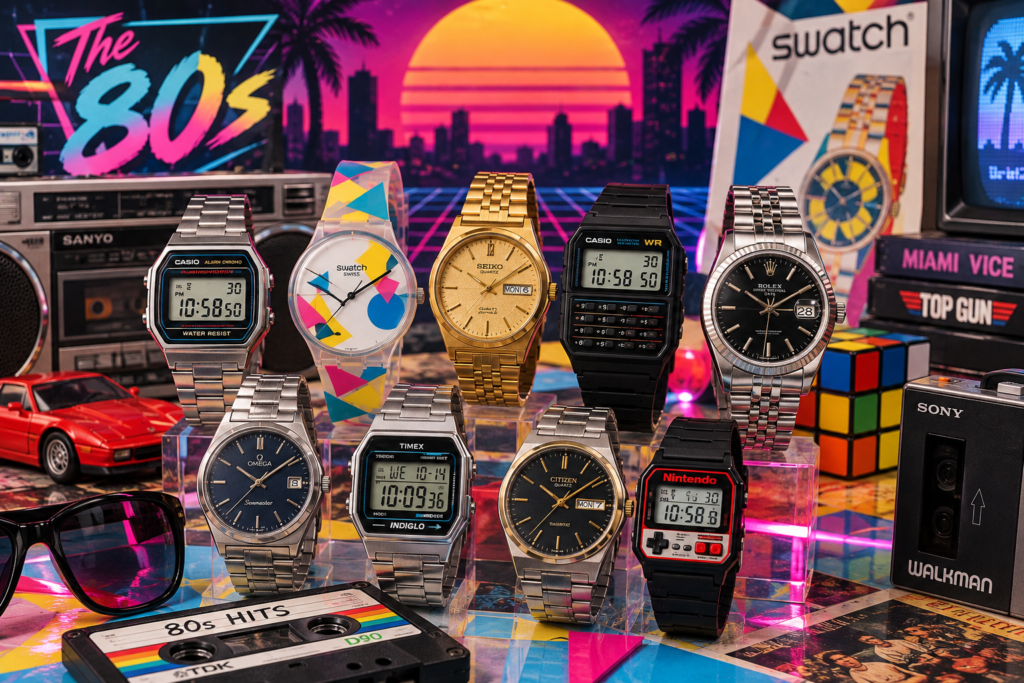
Eighties watches are easy to caricature: neon plastic, calculator buttons and enough gold tone to light a music video. The real decade was more interesting. Traditional Swiss makers were learning how to live with quartz, Japanese brands were treating the wrist as a place for useful electronics, and a new Swiss label called Swatch made an inexpensive watch feel like a collectible design object.
That mix is why the period still works so well on the wrist. You can go unapologetically loud, or choose a small steel digital watch that looks almost restrained today. What ties the best examples together is not nostalgia alone. They are clear, legible designs with a point of view.
What actually changed in the 1980s?
Quartz was no longer a novelty. It had become the practical default, which freed brands to compete on size, functions and personality. Casio put calculators, data storage and alarms into watches. Swatch simplified Swiss production and treated the dial and strap as a canvas. At the other end of the market, Rolex, Cartier and other luxury houses leaned into recognizable shapes and two-tone finishes rather than trying to imitate digital technology.
The models that explain the decade
Casio C-80 and the calculator-watch idea
Casio released the C-80 in 1980 with a keypad that could be operated directly by a fingertip and an eight-digit calculator. It was not merely a prop from a science-fiction film; it was a genuinely useful little machine at a time when a calculator was not already in everyone’s pocket. Later calculator models refined the idea into the slim black format people now associate with the category.
G-Shock DW-5000C
The first G-Shock arrived in 1983. Its importance is easier to understand if you remember that watches were commonly treated as delicate objects. Casio built the DW-5000C around a shock-resistant structure and protected it with urethane. The square outline still anchors the 5000 and 5600 families today.
Swatch Originals
Swatch debuted in 1983 with a slim plastic case, quartz movement and a low enough price to encourage owning more than one. The clever part was not plastic by itself; it was the constant rhythm of new graphics, colors and artist editions. A watch could now behave like a seasonal fashion item without feeling disposable in spirit.
Rolex GMT-Master II
Rolex took a different path. In 1982 it introduced the GMT-Master II with an independently adjustable local-hour hand. That improvement made changing time zones much easier and gave the decade a serious mechanical travel watch alongside its playful digital icons.
Reference: Casio’s official 1980s watch history.
Reference: Rolex GMT-Master II history.
How to wear an ’80s watch without looking costumed
Choose one period signal and keep everything around it quiet. A resin calculator watch works with a plain T-shirt and denim because the watch supplies the joke. A small two-tone Datejust-style watch looks sharper with neutral clothes than it does with a head-to-toe retro outfit. Swatch is the exception: clashing color is part of the appeal, so there is no need to make it behave.
Size also matters. Many original watches from the decade are smaller than current product photography suggests. Check the case width, lug-to-lug measurement and bracelet length before buying. A 34–36 mm watch can feel intentional and elegant; it should not be judged by modern sports-watch proportions.
Original vintage or a current descendant?
Vintage gives you the materials and proportions of the period, but it also brings old seals, brittle resin and uncertain service history. A current CA-53W or square G-Shock delivers most of the visual effect with easy battery replacement and known water resistance. Neither choice is more “authentic”; they solve different problems.
Buying an original: three checks that save trouble
- Confirm the reference and module. Sellers often describe any small Casio as “1980s.” The case-back number is more useful than the listing title.
- Assume water resistance is gone. Unless a watch has been pressure-tested recently, keep it dry—even if the dial says 50 m or 200 m.
- Inspect resin and LCDs in person or on video. Cracked bezels, leaking LCDs and missing bracelet links can cost more to solve than the watch itself.
The best 1980s watch is not necessarily the rarest one. It is the one whose odd little idea—color, calculation, toughness or travel—still makes sense every time you put it on.