
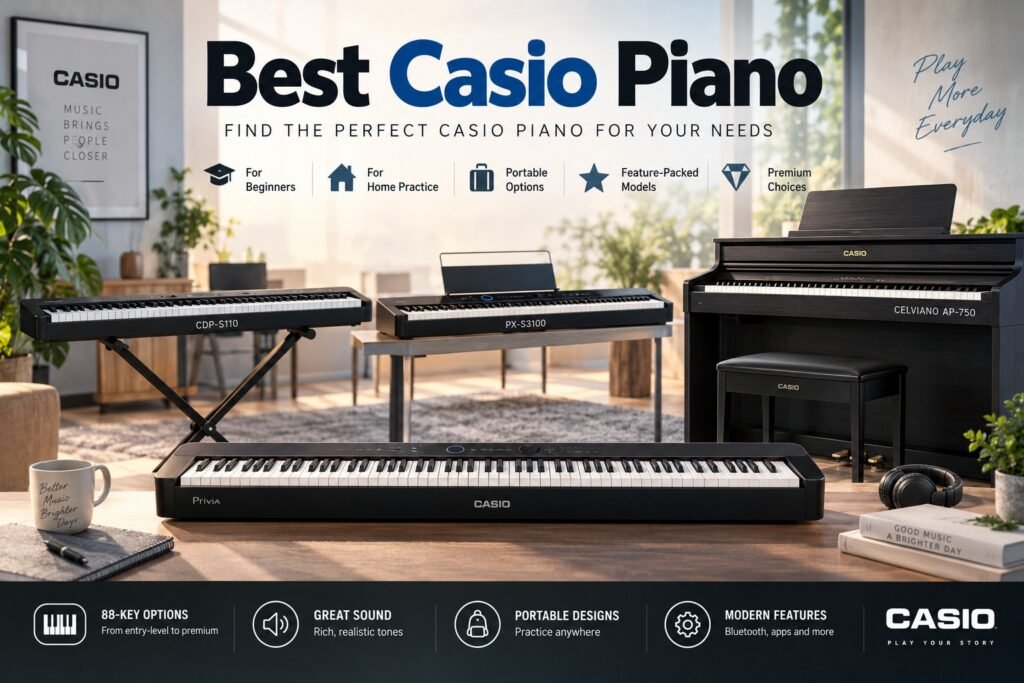
Casio’s digital piano range covers almost every kind of buyer, from someone ordering a first weighted keyboard to an experienced pianist looking for a permanent instrument for the living room. The difficult part isn’t finding a Casio with enough features. It’s figuring out which features are actually worth paying for.
For piano learning, I would make one decision before looking at anything else: do you need a real 88-key weighted keyboard?
If the answer is yes, the inexpensive CDP models already give you a sensible starting point. Spend more and you move into the Privia range, where the differences become less about simply having 88 keys and more about action, sound, controls, speakers, portability and overall refinement. At the top, Celviano changes the equation again by prioritizing a permanent piano-style setup rather than portability.
For most beginners, you do not need Casio’s most expensive piano. You need the model that gives you enough room to improve without paying for capabilities you may never use.
Our Picks
| Pick | Casio piano | Best for |
|---|---|---|
| 💰 Best budget Casio piano | Casio CDP-S110 | Learning piano on a tighter budget |
| 🎹 Best versatile beginner piano | Casio CDP-S360 | Beginners who also want lots of sounds and accompaniment |
| ⭐ Best Casio piano overall | Casio PX-S1100 | Most beginners and home players |
| 🎛️ Best for features | Casio PX-S3100 | Players who want piano feel plus extensive sounds and controls |
| 🎼 Best portable piano for serious playing | Casio PX-S5000 | Players who care more about key feel |
| 🏠 Best premium modern piano | Casio PX-S6000 | Home playing, sound and performance features |
| ✨ Best Casio piano for design | Casio PX-S7000 | A premium piano that becomes part of the room |
| 🎹 Best traditional home piano | Casio Celviano AP Series | A permanent family or living-room setup |
| 🏆 Best premium Casio | Casio Celviano Grand Hybrid | Experienced players shopping at the high end |
What Is the Best Casio Piano Overall?
For most people looking for a serious first digital piano, my pick is the Casio Privia PX-S1100.
It gets the important things right without becoming unnecessarily complicated. There are 88 weighted keys, 192-note maximum polyphony, Casio’s Multi-Dimensional Morphing AiR sound source, built-in speakers and a remarkably shallow cabinet. Casio also gives it 18 tones rather than filling the instrument with hundreds of sounds that a piano-focused beginner may rarely use. (Casio)
The PX-S1100 isn’t the cheapest option here. The CDP-S110 makes more sense if keeping the initial cost down matters most. And if you want hundreds of tones, rhythms and accompaniment features, the CDP-S360 or PX-S3100 is the more interesting direction.
That’s why “best” needs context.
For most people who tell me simply, “I want to learn piano and I want something good enough to keep,” the PX-S1100 is the sweet spot.
—
Best Casio Pianos of 2026
Best Budget Casio Piano
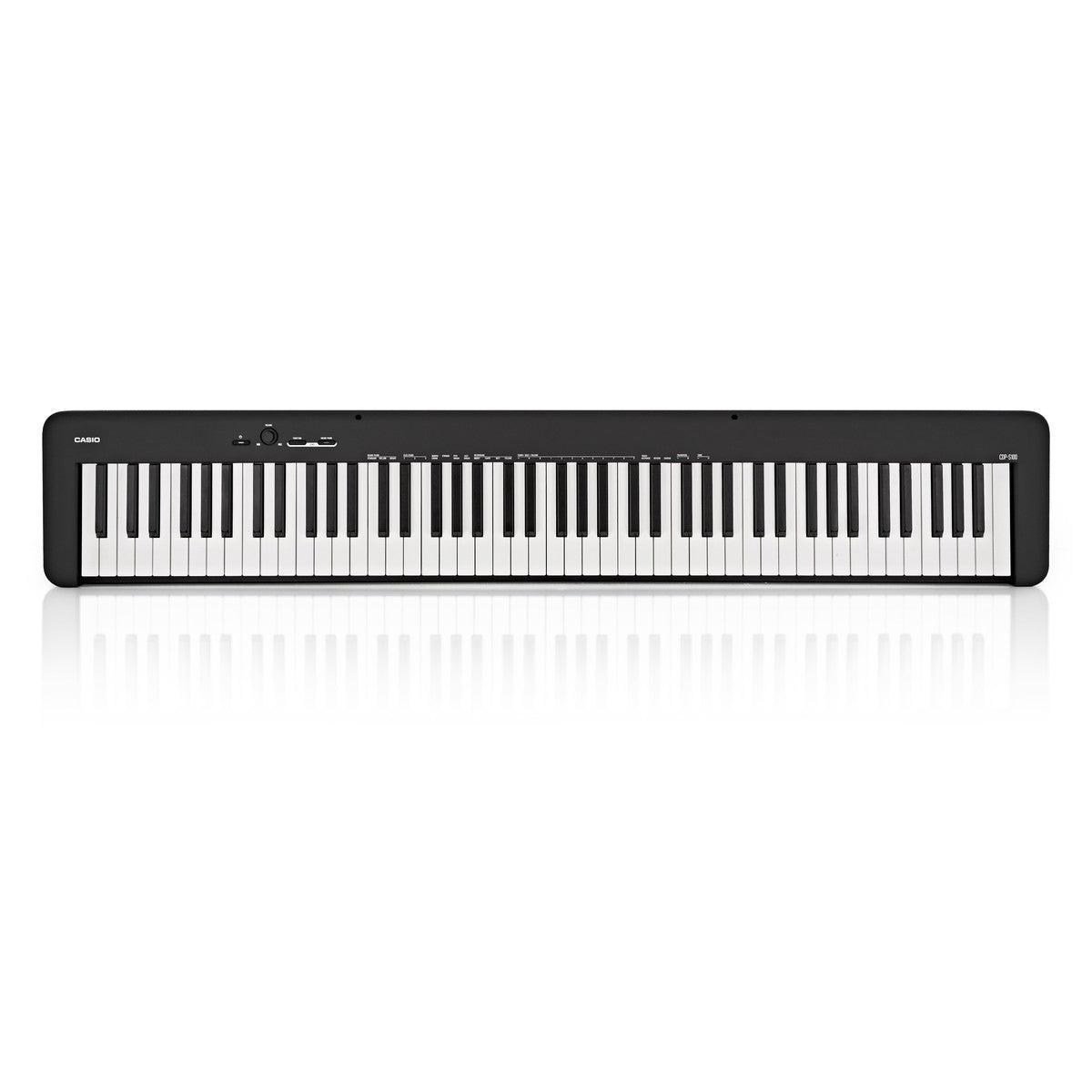
Casio CDP-S110
The CDP-S110 is where I would start if the budget is limited but the goal is actually learning piano.
Its specification sheet isn’t spectacular, and that’s part of the point. You get an 88-key Scaled Hammer Action Keyboard II, three touch-response settings, 64-note maximum polyphony, 10 tones and two 8W amplifiers. The piano weighs about 10.5 kg and can also operate from six AA batteries. (Casio)
It doesn’t try to win a feature-count competition.
Instead, the CDP-S110 gets you onto a full-size weighted keyboard without forcing you into the price of the Privia range.
Pros
- ✅ 88 weighted keys at the affordable end of Casio’s range
- ✅ Compact 232 mm depth
- ✅ Relatively light at about 10.5 kg
- ✅ Built-in speakers
- ✅ Headphone/output connection
- ✅ USB connectivity
- ✅ Battery operation available
- ✅ Good foundation for a beginner learning traditional piano
Cons
- ❌ 64-note polyphony is modest compared with higher models
- ❌ Only 10 tones
- ❌ Key action and overall refinement are below the Privia models
- ❌ Basic included pedal
- ❌ Easy to outgrow if you become a more demanding player
Our Take
The CDP-S110 makes sense because it spends the budget in the right place.
A beginner may be tempted by a cheaper keyboard advertising hundreds of sounds, rhythms and effects. Those features can be fun, but they don’t replace weighted keys when you’re trying to develop piano technique.
Scales, chords, dynamics and finger control all involve the physical relationship between your hands and the keyboard.
That’s why I’d rather start with a CDP-S110 and a stable stand than buy a feature-heavy unweighted keyboard just because the box promises more functions.
The limitation becomes clearer as you progress. The action is still entry-level, and the sound system and overall experience are less sophisticated than what you get farther up Casio’s range.
But inexpensive and bad aren’t the same thing.
Who should buy it
Buy the CDP-S110 if you’re starting piano lessons, want 88 weighted keys and need to keep the initial investment reasonable.
It’s also one of the more sensible options for a student or apartment dweller who doesn’t want a large permanent instrument.
Who should skip it
Skip it if you already know you’re committed to piano and can comfortably afford the PX-S1100 or PX-S5000.
Also look elsewhere if arranger functions, a large sound library and accompaniment are important to you.
Key Specs
| Specification | Casio CDP-S110 |
|---|---|
| Keys | 88 |
| Keyboard | Scaled Hammer Action Keyboard II |
| Polyphony | 64 notes |
| Tones | 10 |
| Speakers | 2 |
| Amplification | 8W + 8W |
| Weight | Approx. 10.5 kg |
| Battery power | Yes |
| Best for | Budget-conscious beginners |
Casio’s published specifications confirm these core figures. (Casio)
—
Best Versatile Casio Piano for Beginners
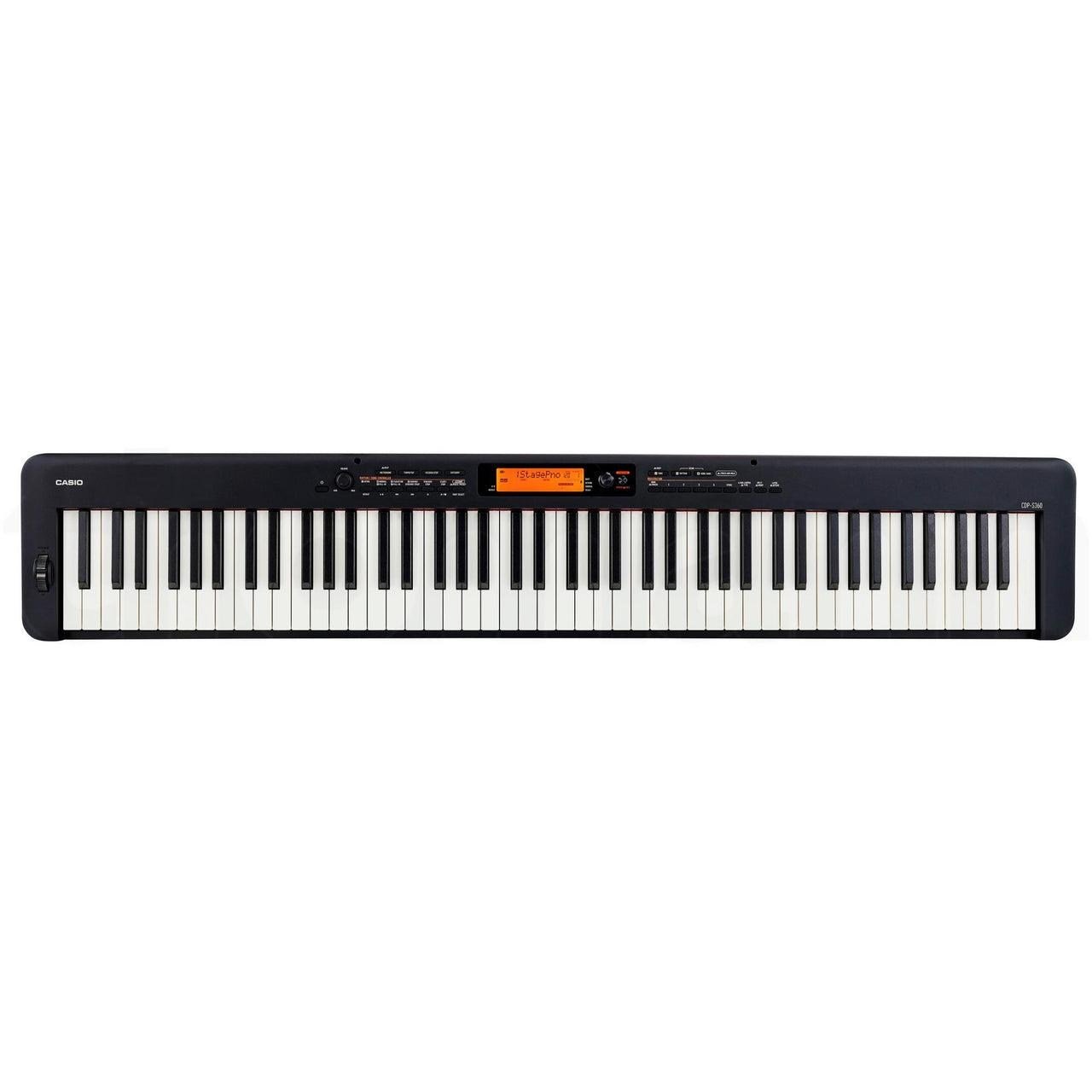
Casio CDP-S360
The CDP-S360 starts with the same basic idea as the CDP-S110 – a compact 88-key weighted digital piano – and then adds a completely different level of musical flexibility.
Casio specifies 700 tones, 128-note maximum polyphony, automatic accompaniment and 152 built-in songs, including exercise phrases. (Casio)
That changes who this piano is for.
Pros
- ✅ 88 weighted keys
- ✅ 700 tones
- ✅ 128-note polyphony
- ✅ Automatic accompaniment
- ✅ Large collection of built-in songs
- ✅ More room for experimenting with different styles
- ✅ Still compact enough to move
- ✅ Optional three-pedal support
Cons
- ❌ Extra features aren’t necessary for straightforward piano study
- ❌ Same fundamental entry-level action family as the CDP-S110
- ❌ More controls and functions can be unnecessary for a piano-only buyer
- ❌ PX-S1100 is the more focused choice if piano itself is the priority
Our Take
This is the CDP I’d choose for someone who doesn’t want their instrument to be only a piano.
One evening you may be practicing a piano piece. The next you might want an electric piano, strings or accompaniment behind some chords. The 700-tone library and arranger-style functionality make the CDP-S360 far more useful for that kind of experimentation.
But there’s an important trap here.
More features do not automatically mean a better piano.
If your only objective is to sit down every day and learn traditional piano technique, I’d put key feel and the core piano experience ahead of the number of sounds.
Who should buy it
The CDP-S360 makes sense for beginners, hobby players and families who want a weighted digital piano but also enjoy exploring sounds, accompaniment and different styles of music.
Who should skip it
If you’re buying specifically for piano lessons and expect to spend almost all your time using one acoustic piano sound, consider putting the extra money toward a Privia instead.
Key Specs
| Specification | Casio CDP-S360 |
|---|---|
| Keys | 88 |
| Keyboard | Scaled Hammer Action Keyboard II |
| Polyphony | 128 notes |
| Tones | 700 |
| Automatic accompaniment | Yes |
| Built-in songs | 152 |
| Speakers | 2 |
| Amplification | 8W + 8W |
| Best for | Piano + lots of sounds/features |
(Casio)
—
Best Casio Piano Overall
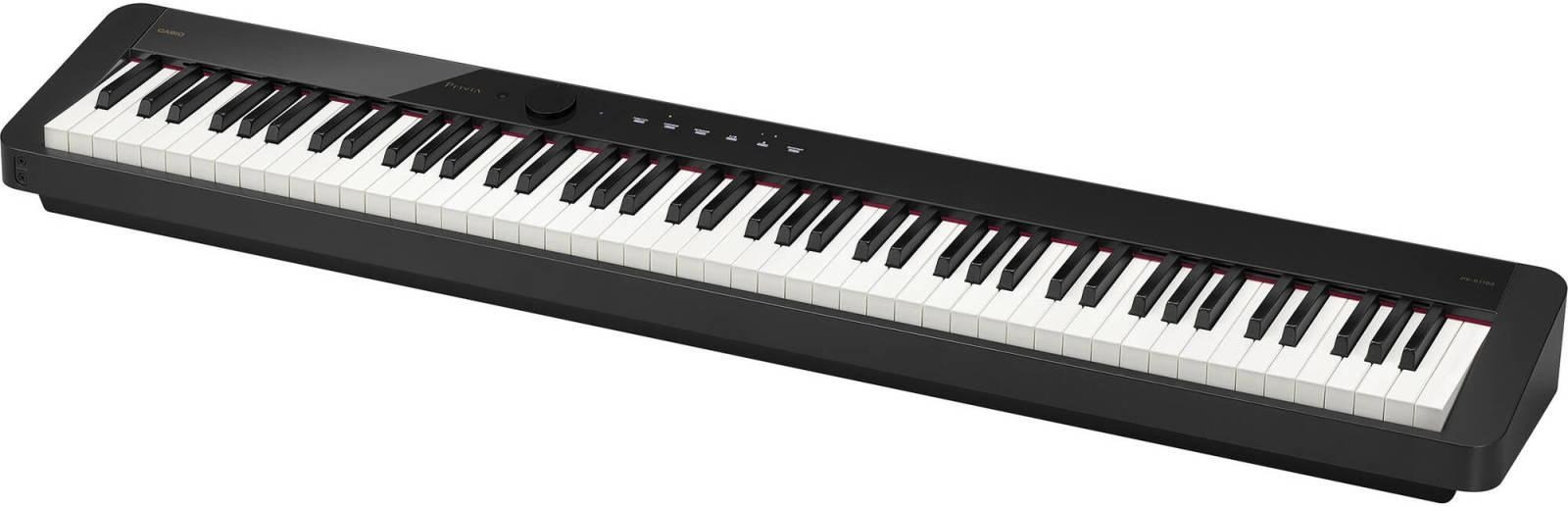
Casio Privia PX-S1100
The PX-S1100 is the model I’d recommend to the widest range of buyers.
It has 88 keys with Casio’s Smart Scaled Hammer Action Keyboard, 192-note polyphony, 18 tones, two 8W amplifiers and support for the optional SP-34 three-pedal unit. Despite all of that, the body is only 232 mm deep. (Casio)
That compactness isn’t just a specification. It changes where you can realistically keep the piano.
Pros
- ✅ 88 weighted keys
- ✅ 192-note polyphony
- ✅ Compact Privia design
- ✅ Strong balance between price and long-term usefulness
- ✅ Built-in speakers
- ✅ Optional three-pedal setup with half-damper support
- ✅ MIDI and audio recording
- ✅ Battery operation
- ✅ Easy to integrate into a small home setup
Cons
- ❌ More expensive than the CDP-S110
- ❌ Only 18 tones if you want a huge sound library
- ❌ More advanced players may eventually want a better action
- ❌ Minimal controls won’t appeal to everyone
Our Take
What I like most about the PX-S1100 is that it doesn’t encourage a beginner to pay for the wrong things.
Eighteen tones sound unimpressive next to the 700 available on the PX-S3100. But if you’re buying a digital piano because you want to play piano, that difference may barely matter.
The more important advantages are the overall piano-focused package, compact body and enough capability to remain useful after the first few months of lessons.
Put it on a proper stand and it works as a home piano. Add headphones and it becomes practical for late-night practice. If you move house, you’re not dealing with a 50 kg cabinet.
That’s a very useful combination.
Who should buy it
The PX-S1100 is my first choice for most beginners, returning players and casual-to-intermediate pianists who want a proper digital piano without dedicating a permanent part of the room to a large cabinet.
Who should skip it
Skip it if 700 sounds, accompaniment and performance controls are important. That’s where the PX-S3100 starts making more sense.
If key action is already one of your main concerns, go farther up the range and try the PX-S5000.
Key Specs
| Specification | Casio PX-S1100 |
|---|---|
| Keys | 88 |
| Keyboard | Smart Scaled Hammer Action |
| Sound engine | Multi-Dimensional Morphing AiR |
| Polyphony | 192 notes |
| Tones | 18 |
| Speakers | 2 |
| Amplification | 8W + 8W |
| Optional 3-pedal unit | Yes |
| Battery power | Yes |
| Best for | Most beginners and home players |
(Casio)
CDP-S110 vs PX-S1100: Is the Privia Worth More?
This is still one of the most useful comparisons for a first-time Casio buyer.
| CDP-S110 | PX-S1100 | |
|---|---|---|
| Keys | 88 weighted | 88 weighted |
| Polyphony | 64 | 192 |
| Tones | 10 | 18 |
| Position | Entry level | Step-up beginner/intermediate |
| Portability | ⭐ Excellent | ⭐ Excellent |
| Main advantage | Lower cost | Better long-term package |
| My choice | Tight budget | Most beginners |
If you’re testing the waters and don’t know whether piano will still interest you six months from now, the CDP-S110 is a rational purchase.
If you’re already motivated and the price difference doesn’t strain the budget, I’d choose the PX-S1100.
—
Best Feature-Packed Portable Casio Piano
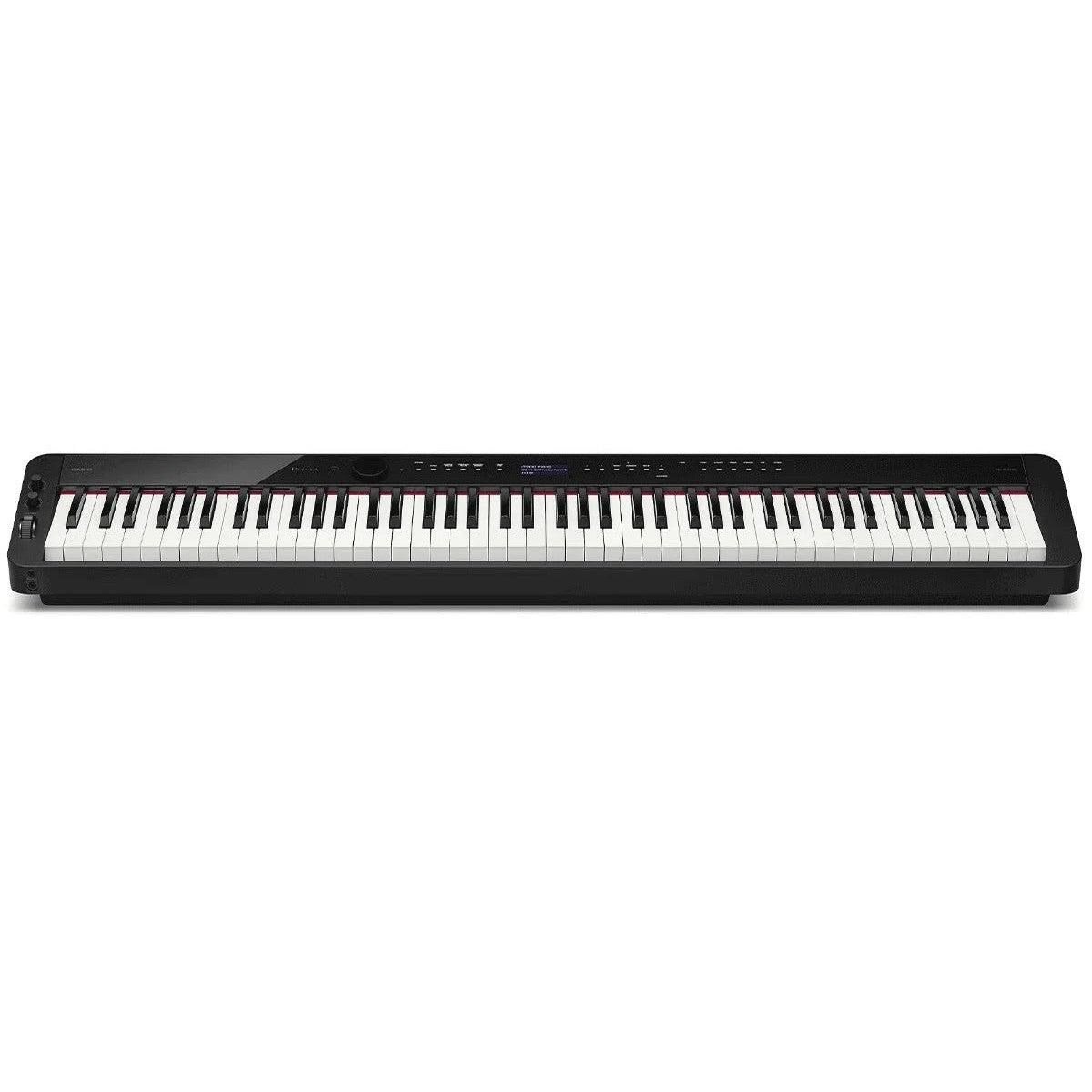
Casio Privia PX-S3100
The PX-S3100 takes the slim Privia concept in a much more feature-heavy direction.
You still get an 88-key Smart Scaled Hammer Action Keyboard and 192-note maximum polyphony, but the sound library jumps to 700 tones. There are also 200 rhythms, automatic accompaniment and more capable recording functions. (Casio)
Pros
- ✅ 88 weighted keys
- ✅ 192-note polyphony
- ✅ 700 tones
- ✅ 200 rhythms
- ✅ Automatic accompaniment
- ✅ More flexible recording
- ✅ Slim, portable design
- ✅ Good fit for pop, performance and experimentation
Cons
- ❌ Overkill for many beginners
- ❌ Extra features don’t improve basic piano technique
- ❌ Costs more than the PX-S1100
- ❌ Piano-focused buyers may rarely use most of the sound library
Our Take
Think of the PX-S3100 as the Privia for the person who keeps looking at the PX-S1100 and asking, “What else can it do?”
Quite a lot.
The larger sound library, rhythms and accompaniment make it a much more flexible instrument outside traditional piano practice.
That’s genuinely valuable for a player interested in pop, arranging, songwriting or simply experimenting.
But don’t buy it because 700 is a bigger number than 18.
A surprising amount of digital piano ownership consists of selecting your favorite acoustic piano tone and leaving it there for months.
If that’s likely to be you, the PX-S1100 is the smarter purchase.
Who should buy it
Choose the PX-S3100 if you want one compact instrument that can function as a piano, creative keyboard and flexible performance tool.
Who should skip it
Skip it if you’re primarily learning piano and have no particular interest in accompaniment, hundreds of tones or expanded performance controls.
—
Best Portable Casio for More Serious Piano Playing
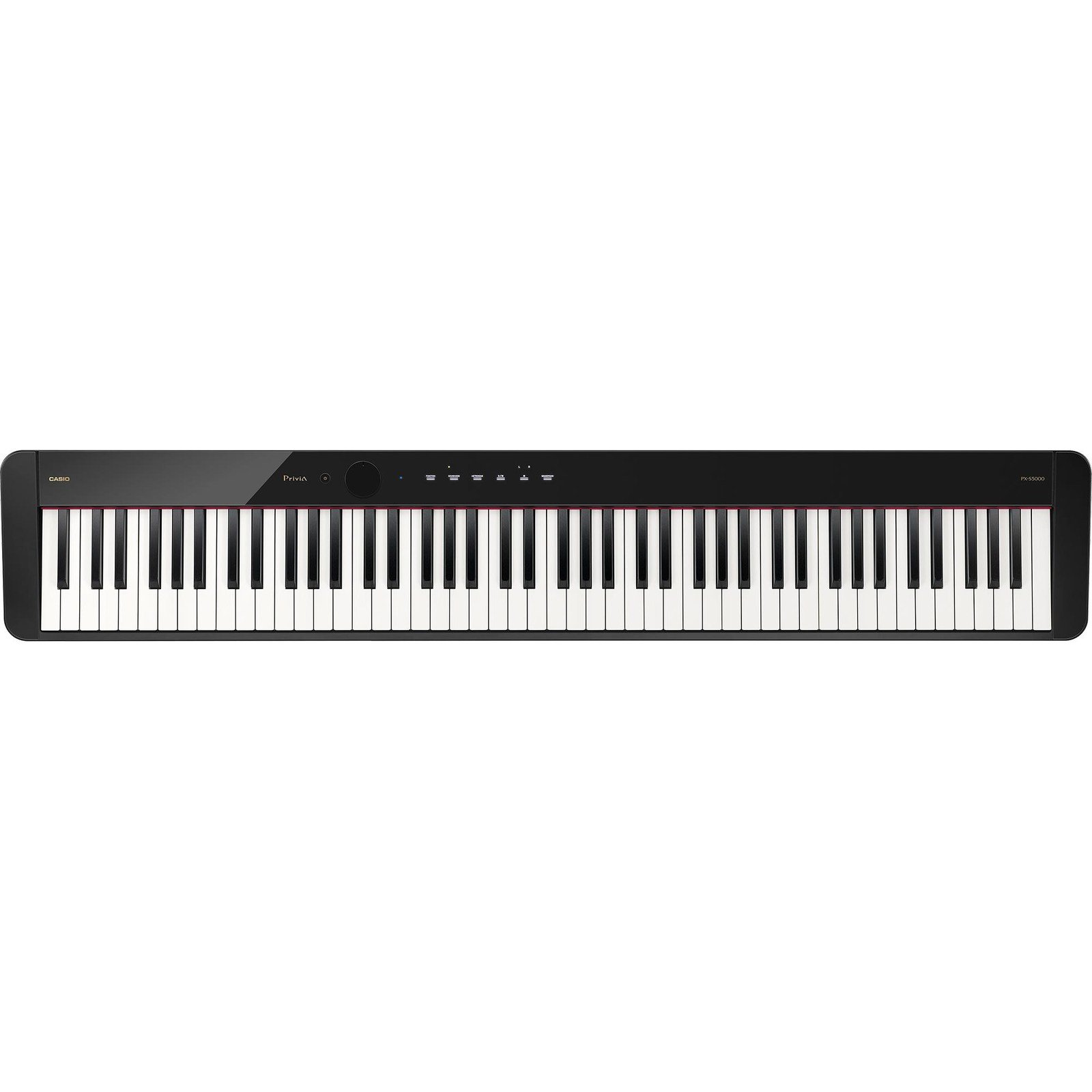
Casio Privia PX-S5000
At the PX-S5000, the reason to spend more starts changing.
Instead of simply adding more sounds, Casio moves to its Smart Hybrid Hammer Action Keyboard with wood/resin hybrid keys. The PX-S5000 has 23 tones, 192-note polyphony and retains the remarkably shallow 232 mm Privia body. (Casio)
That’s a more interesting upgrade for a pianist.
Pros
- ✅ Smart Hybrid Hammer Action Keyboard
- ✅ Wood/resin hybrid key construction
- ✅ 88-key digital scaling
- ✅ 192-note polyphony
- ✅ Extremely slim for an 88-key hammer-action instrument
- ✅ Only about 11.5 kg
- ✅ Strong piano-focused specification
- ✅ Battery operation remains possible
Cons
- ❌ Considerably more expensive than beginner models
- ❌ Only 23 tones
- ❌ Beginners may not appreciate the action enough to justify the price
- ❌ Still a slab piano unless you add a suitable stand and pedal setup
Our Take
This is where I’d stop counting features and start paying attention to your fingers.
If you’re already playing, a better keyboard action can matter every single time you sit down. That’s very different from paying for an obscure software feature you use twice.
The PX-S5000 is therefore easier to justify for someone who already knows they’re committed to playing.
It can also make sense as an ambitious first purchase if the budget is comfortable and you’d rather avoid upgrading soon.
Who should buy it
Intermediate players, committed beginners and anyone who wants a better action without giving up the unusually compact Privia format.
Who should skip it
A brand-new player on a limited budget probably won’t get enough additional value from it yet. Put that money into lessons, a stable setup and regular practice.
Key Specs
| Specification | Casio PX-S5000 |
|---|---|
| Keys | 88 |
| Keyboard | Smart Hybrid Hammer Action |
| Key material | Wood/resin hybrid |
| Polyphony | 192 |
| Tones | 23 |
| Depth | 232 mm |
| Weight | Approx. 11.5 kg |
| Best for | More serious piano playing |
(Casio)
—
Best Premium Modern Casio Piano
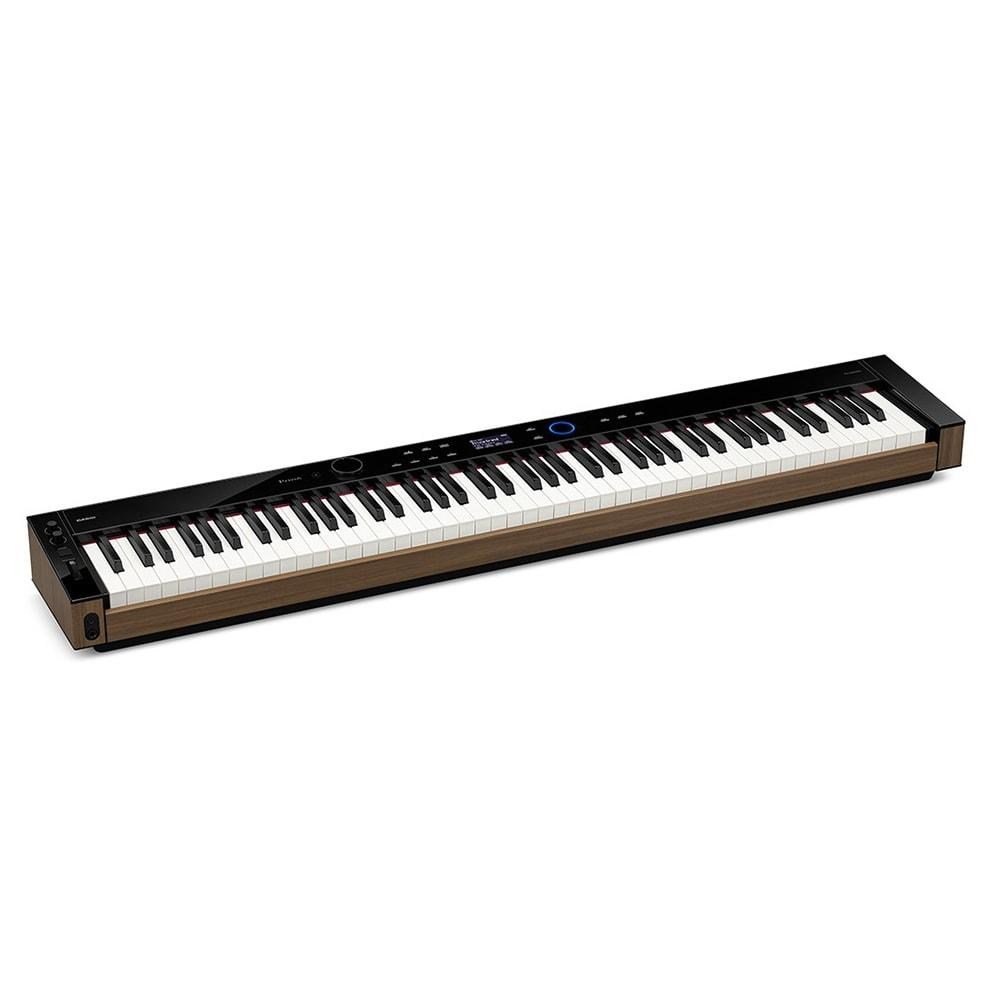
Casio Privia PX-S6000
The PX-S6000 keeps the slim Privia philosophy but pushes much farther into premium home and performance territory.
Casio gives it the Smart Hybrid Hammer Action Keyboard, 256-note polyphony, 350 tones and a four-speaker Spatial Sound System. It also adds a backlit LCD, pitch bend, modulation, assignable controls, microphone input and extensive effects. (Casio)
Pros
- ✅ Smart Hybrid Hammer Action Keyboard
- ✅ 256-note polyphony
- ✅ 350 tones
- ✅ Four-speaker Spatial Sound System
- ✅ More advanced controls
- ✅ Microphone input
- ✅ Strong home and performance flexibility
- ✅ Premium design without becoming a traditional cabinet piano
Cons
- ❌ Far more instrument than most beginners need
- ❌ More expensive than piano-focused alternatives
- ❌ Added performance features won’t matter to everyone
- ❌ Still requires a separate stand/pedal decision for a permanent setup
Our Take
The PX-S6000 is interesting because it isn’t simply a “better PX-S5000.”
It’s aimed at a broader use case.
The upgraded speaker system matters for someone who plays without headphones. The 350 tones and real-time controls matter for someone who performs or experiments. And the design matters if this piano will stay visible in a modern living space.
If all you want is an excellent keyboard for piano practice, you may not need everything you’re paying for here.
Who should buy it
Choose the PX-S6000 if you want premium key action, much more sound and control flexibility, and a digital piano that can work equally well as a serious home instrument and a creative performance tool.
Who should skip it
If you use one piano sound, mostly practice through headphones and don’t care about performance controls, the PX-S5000 may be the more focused purchase.
—
Best Casio Piano for Design
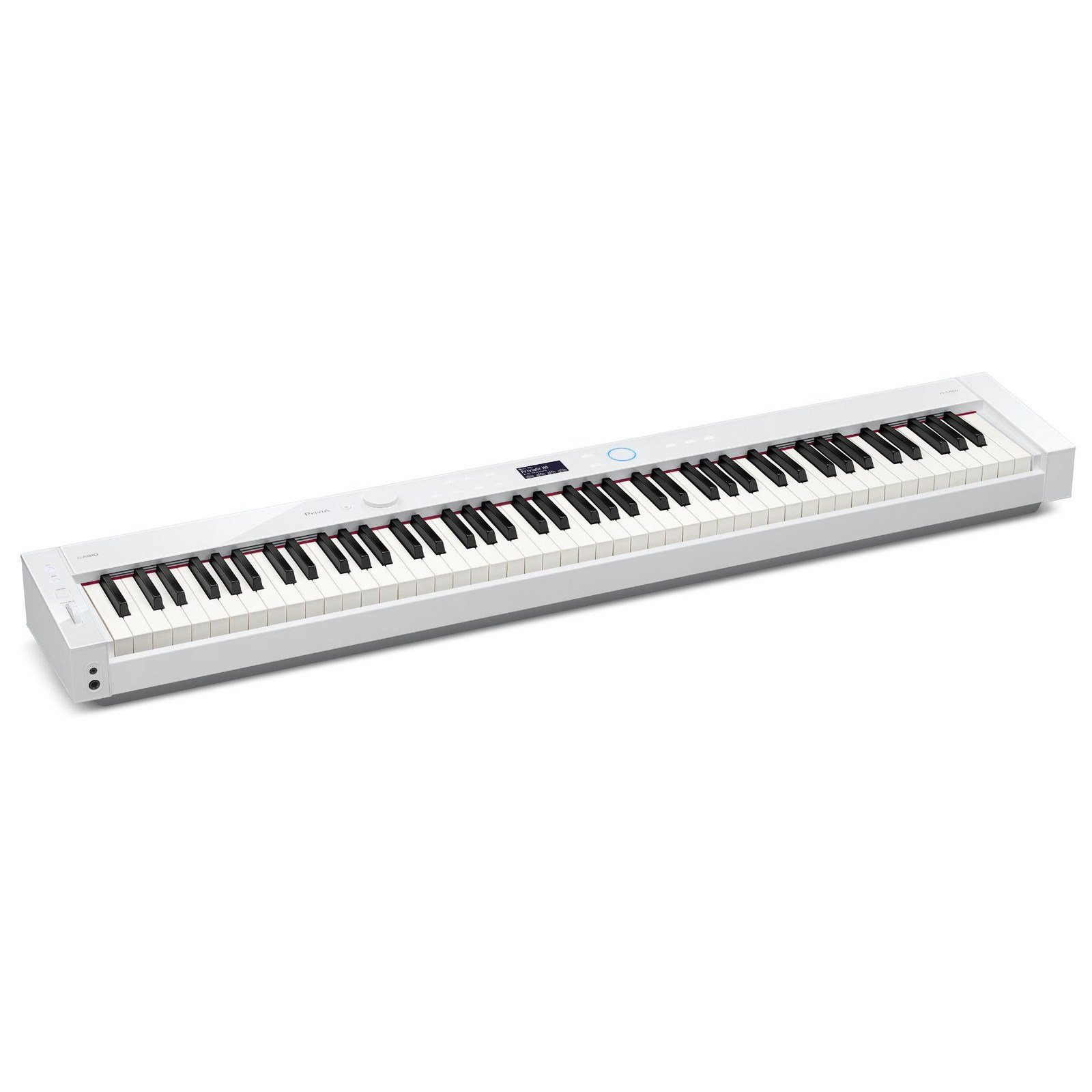
Casio Privia PX-S7000
The PX-S7000 is the point where furniture becomes part of the specification.
It uses Casio’s Smart Hybrid Hammer Action Keyboard, offers 400 tones and 256-note polyphony, and has a four-channel, four-speaker Spatial Sound System. The package also includes a fixed stand and three-pedal unit. (Casio)
That integrated setup changes the experience considerably.
Pros
- ✅ Smart Hybrid Hammer Action
- ✅ 256-note polyphony
- ✅ 400 tones
- ✅ Four-speaker system
- ✅ Integrated stand
- ✅ Fixed three-pedal unit
- ✅ Distinctive modern furniture-style design
- ✅ Strong combination of piano and performance features
Cons
- ❌ Expensive
- ❌ You’re paying partly for design and integration
- ❌ Less attractive if portability is the main reason you’re considering Privia
- ❌ Unnecessary for a beginner who simply needs a good practice instrument
Our Take
There’s a practical side to beautiful instruments that specification comparisons miss.
A piano that’s permanently assembled, correctly positioned and ready to play creates less friction.
A keyboard stored in a box, with the stand folded somewhere else and the pedal lost behind a cupboard, has to be “set up” every time inspiration arrives.
That sounds trivial until it stops you practicing.
The PX-S7000 turns the Privia concept into something you can deliberately build a room around.
That’s valuable – but be clear about what you’re buying. A large part of the reason to choose it over a cheaper Privia is the complete physical package and design.
Who should buy it
Someone who wants a premium modern digital piano that stays permanently visible in a living room and looks intentional rather than temporary.
Who should skip it
Anyone primarily shopping for value or portability. You can get the fundamentals of piano learning for dramatically less money.
—
Best Traditional Casio Home Piano
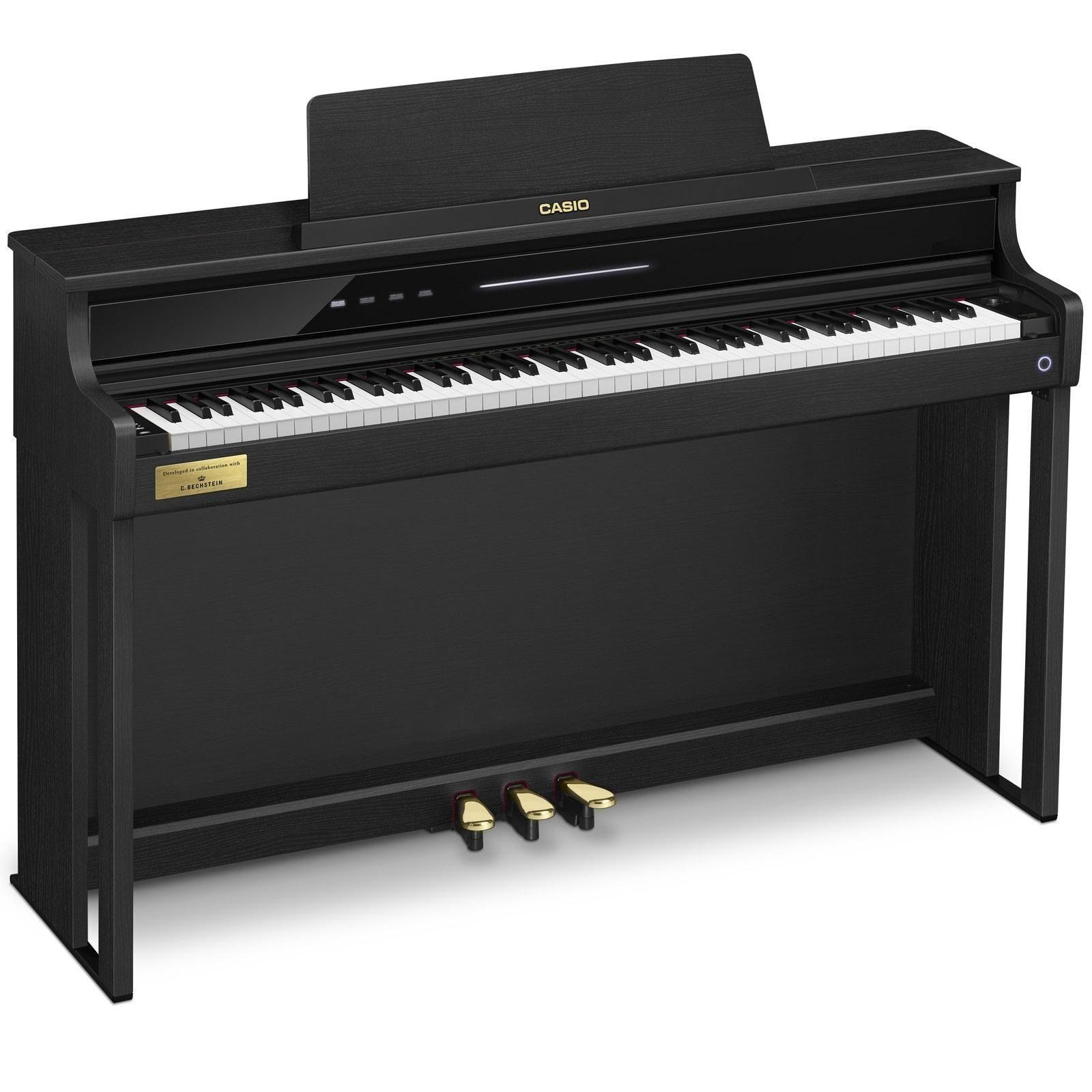
Casio Celviano AP Series
Not everyone should buy a portable slab piano.
If the instrument will stay in one place for years, Casio’s Celviano AP family deserves serious consideration.
A current model such as the AP-750 uses an 88-key Smart Hybrid Hammer Action Keyboard with wood/resin hybrid construction, Casio’s AiR Grand sound source, 256-note polyphony, integrated three pedals and an eight-speaker system. The complete instrument weighs 53.6 kg. (Casio)
This is a very different proposition from carrying a CDP or Privia between rooms.
Pros
- ✅ Permanent piano-style cabinet
- ✅ Fixed playing position
- ✅ Integrated three-pedal system
- ✅ Smart Hybrid Hammer Action on higher AP models
- ✅ Stronger built-in speaker experience
- ✅ Better fit for a dedicated home piano
- ✅ No separate stand or pedal arrangement required
Cons
- ❌ Not meaningfully portable
- ❌ Requires dedicated floor space
- ❌ Higher initial cost
- ❌ Less appropriate for students who move frequently
Our Take
The appeal of Celviano is consistency.
The bench goes in front of it. The pedals stay in place. The playing height doesn’t change because somebody moved the keyboard to a desk. You walk over, switch it on and play.
For a family instrument, that matters.
You still retain one of the biggest benefits of a digital piano: plug in headphones and practice without making everyone else listen to the same difficult eight measures fifty times.
Who should buy it
Families, committed learners and home pianists who already know where the instrument will live.
Who should skip it
Students, renters and anyone who expects to move the piano regularly should think carefully before committing to a cabinet model.
—
Best Premium Casio Piano
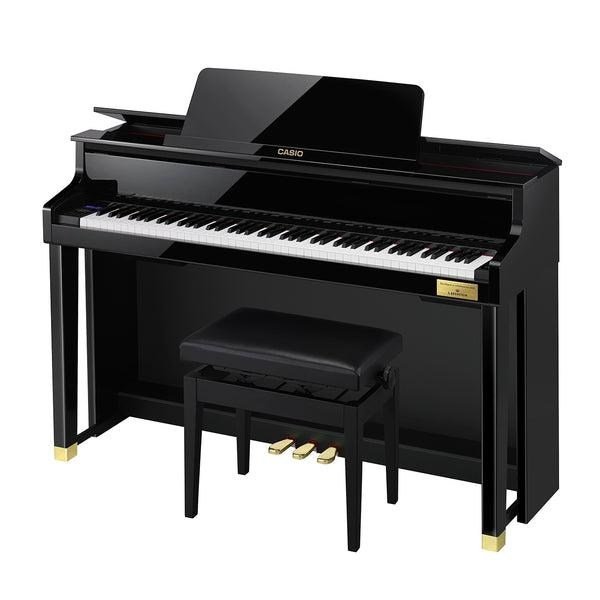
Casio Celviano Grand Hybrid
Grand Hybrid is where the familiar “Casio makes affordable keyboards” stereotype stops being useful.
These instruments are aimed at experienced players looking for a much closer bridge between digital convenience and the physical experience of an acoustic grand.
At this level, however, my recommendation changes completely:
Don’t choose from a specification table alone.
Pros
- ✅ Premium Casio piano experience
- ✅ Designed for demanding piano players
- ✅ Much greater emphasis on acoustic-piano feel
- ✅ Permanent three-pedal furniture-style configuration
- ✅ Digital conveniences without the maintenance requirements of an acoustic grand
- ✅ Appropriate competitor to premium digital pianos from other major brands
Cons
- ❌ Expensive
- ❌ Large and heavy
- ❌ Completely unnecessary for most beginners
- ❌ Keyboard feel becomes too personal to judge from specifications alone
Our Take
Once you’re spending several thousand dollars, the buying process should change.
Go play one.
Then play the nearest Yamaha, Roland and Kawai alternatives.
Use the same piece. Play quietly. Play loudly. Repeat notes. Try chords. Move from the bass into the upper register. Use the pedals. Listen through the speakers and through the headphones if headphones will be part of your normal routine.
At this level, your reaction to the instrument matters more than whether one specification column contains a larger number.
Who should buy it
Experienced pianists, serious players and buyers who want a permanent premium digital piano and already know what they like in a keyboard action.
Who should skip it
Beginners looking for the “best” Casio because they assume the most expensive model must also be the best model to learn on.
It isn’t.
—
Casio Digital Pianos Compared
| Model / Series | Keys | Polyphony | Tones | Main Strength | Best For |
|---|---|---|---|---|---|
| CDP-S110 | 88 weighted | 64 | 10 | Low-cost entry into weighted keys | Beginners on a budget |
| CDP-S360 | 88 weighted | 128 | 700 | Huge feature set for the price | Piano + sounds/accompaniment |
| PX-S1100 | 88 weighted | 192 | 18 | Excellent overall balance | Most beginners |
| PX-S3100 | 88 weighted | 192 | 700 | Features + portability | Creative/home players |
| PX-S5000 | 88 weighted | 192 | 23 | Upgraded key action | More serious players |
| PX-S6000 | 88 weighted | 256 | 350 | Action + speakers + controls | Premium modern setup |
| PX-S7000 | 88 weighted | 256 | 400 | Integrated design | Premium living room |
| Celviano AP | 88 weighted | Up to 256* | Varies | Cabinet experience | Permanent home piano |
| Grand Hybrid | 88 | Varies by model | Varies | Premium piano experience | Advanced players |
*Specifications vary across the Celviano AP range. For example, the current AP-750 uses 256-note polyphony. (Casio)
—
What to Consider When Choosing a Casio Digital Piano
1. Weighted Keys Matter More Than a Huge Sound Library
If your goal is learning piano rather than simply learning songs on a keyboard, weighted action should be near the top of your list.
That’s why the CDP-S110 remains a more sensible starting point for traditional piano study than many cheaper 61-key keyboards with much longer feature lists.
Your fingers interact with the keyboard thousands of times.
The number of saxophone sounds buried in a menu matters considerably less.
2. 61 Keys vs 88 Keys
A beginner won’t use all 88 keys on the first day.
That doesn’t make 88 keys pointless.
The benefit is partly range, but the more important issue when comparing Casio’s inexpensive keyboards with its digital pianos is often the action.
Many Casiotone keyboards use lightweight keys. They’re perfectly useful for learning melodies, chords, music theory, pop accompaniment and simply discovering whether you enjoy making music.
For traditional piano study, I’d start with an 88-key weighted CDP or Privia whenever the budget allows.
3. Don’t Buy Polyphony in Isolation
Polyphony tells you how many notes the sound engine can reproduce simultaneously, but a larger number isn’t automatically audible as a better piano.
The CDP-S110 has 64-note maximum polyphony, while the PX-S1100 and PX-S5000 offer 192 and the PX-S6000/PX-S7000 reach 256. (Casio)
More headroom becomes useful with sustained notes, layered sounds and more complex arrangements.
But a beginner shouldn’t reject an otherwise suitable piano simply because another model has a bigger polyphony number.
4. Key Action Becomes More Important as You Improve
A complete beginner may notice that one keyboard feels “heavier” than another without being able to explain much more.
An experienced player can become far more particular.
That’s why the PX-S5000’s Smart Hybrid Hammer Action is a more meaningful upgrade for a committed pianist than it may be for someone taking their first lesson.
If you’re spending heavily because of keyboard feel, try the instrument in person whenever possible.
5. Portable vs Permanent
This decision eliminates half the range surprisingly quickly.
Choose CDP or Privia if:
- you live in a small apartment;
- you expect to move;
- you need to transport the piano;
- you don’t have a permanent piano location;
- compact depth matters.
Consider Celviano if:
- the piano will stay in one room;
- you want fixed pedals;
- you prefer a traditional playing position;
- you don’t want a separate stand;
- the instrument is intended for family use.
Neither approach is inherently better.
6. Speakers Matter More If You Rarely Use Headphones
Built-in speaker quality matters much less to someone who practices through headphones every evening than to someone who expects the piano to fill a living room.
That distinction becomes important as you move toward models such as the PX-S6000, PX-S7000 and higher Celviano instruments with more elaborate speaker systems. (Casio)
Don’t pay for a speaker system you won’t use.
But don’t underestimate it if the piano will usually be played out loud.
7. Check the Pedal Setup
A small sustain pedal is enough to get started.
As your playing develops, a stable three-pedal system with proper half-damper support becomes much more desirable.
Also think physically.
A loose pedal sliding across a wooden floor is annoying regardless of what the specification sheet says.
For a permanent home setup, fixed pedals are one of the underrated advantages of a cabinet piano.
8. Headphones Can Change Which Piano Makes Sense
If you live with other people or in an apartment, headphone practice is one of the biggest advantages a digital piano has over an acoustic instrument.
It means the best piano for your situation may not be the model with the largest speaker system.
A compact PX-S1100 plus good headphones can be a much more practical everyday instrument than a larger piano you can’t comfortably play at night.
9. Connectivity Is Useful, but Know Why You Need It
USB/MIDI connectivity can be useful for:
- learning software;
- recording;
- notation apps;
- DAWs;
- MIDI control;
- transferring music;
- connecting to Casio’s software ecosystem.
Bluetooth can also be convenient depending on the model and what you’re trying to connect.
But connectivity should support how you actually play. Don’t choose a worse-fitting piano because it has a longer wireless feature list.
—
Casio Privia vs Celviano
The easiest way to understand Casio’s digital piano range is to separate these two families.
Choose Privia if you want:
- a small footprint;
- portability;
- modern styling;
- flexible placement;
- easier moving;
- the option to build your own stand/pedal setup.
Choose Celviano if you want:
- a permanent home piano;
- an integrated cabinet;
- fixed pedals;
- a consistent playing position;
- stronger furniture integration;
- something closer to the routine of owning an acoustic upright.
A PX-S1100 can be a much better piano for someone renting an apartment and moving every few years.
A Celviano can be far more practical for a family that expects the piano to remain in the same room for a decade.
Context matters more than the badge.
—
What About Casio Casiotone Keyboards?
Casiotone models frequently appear when people search for the best Casio piano for beginners.
They shouldn’t automatically be dismissed.
A 61-key Casiotone can be a great first musical instrument, especially for a child or casual player who wants to explore chords, melodies, rhythms and different sounds.
But a keyboard and a digital piano aren’t necessarily the same purchase.
If the goal is:
“I want to explore music and see whether I enjoy playing.”
A Casiotone can make perfect sense.
If the goal is:
“I want to learn piano technique properly.”
I’d prioritize an 88-key weighted CDP or Privia.
—
Best Casio Piano for a Beginner
For the lowest sensible budget, I’d choose the CDP-S110.
It gives a beginner the fundamental feature I don’t want to sacrifice: 88 weighted keys.
If the budget allows more, the PX-S1100 is my preferred beginner Casio overall.
It costs more, but you’re buying an instrument with considerably more room to grow rather than paying primarily for novelty features.
If you want piano plus a large library of sounds and accompaniment, the CDP-S360 becomes much more compelling.
And if you’re already certain that piano is going to be a long-term hobby, try the PX-S5000 before automatically buying an entry-level model.
—
Best Casio Piano for a Child
Start by asking what the child is actually going to do with it.
If they’re beginning formal piano lessons, ask the teacher whether they expect an 88-key weighted instrument. Buying the right keyboard from the beginning can prevent replacing an inexpensive 61-key model surprisingly quickly.
For that situation, the CDP-S110 is a sensible starting point.
The PX-S1100 gives more room to grow if the budget allows.
But if a young child is simply exploring music and nobody yet knows whether piano lessons will last, a less expensive Casiotone can still be the more rational purchase.
There’s no benefit in buying a premium instrument that nobody wants to play.
—
Best Casio Piano for an Apartment
This is one area where Casio’s compact designs make a particularly strong argument.
The CDP-S110 and PX-S1100 are the first two I’d consider.
Both give you 88 weighted keys in cabinets only 232 mm deep. (Casio)
Add headphones and practicing late in the evening becomes much easier.
One practical warning: don’t buy an exceptionally slim piano and then put it on an enormous generic X-stand if saving space was the whole reason you chose it.
Measure the complete setup – piano, stand, bench and space required to sit comfortably – not just the keyboard.
—
Casio vs Yamaha: Which Is Better?
Don’t compare logos. Compare the two actual pianos you’re considering.
Casio is particularly strong at fitting weighted 88-key instruments into very shallow cabinets. Yamaha has its own serious beginner and premium digital piano ranges, while Roland and Kawai deserve to be in the same conversation.
Keyboard feel is personal enough that two experienced pianists can try the same pair and disagree.
If you can visit a music store, don’t just press middle C a few times.
Play something you know.
Play quietly and loudly. Repeat notes. Play chords. Move through the low and high registers. Test the pedal. Try headphones if that’s how you’ll usually practice.
Ten useful minutes at the keyboard can tell you more about your preference than another hour comparing specifications online.
—
How We Chose These Casio Pianos
This guide isn’t based on pretending that every Casio model can be reduced to one universal score.
We compared the models according to the job they’re actually intended to do.
The main factors were:
- keyboard type and key action;
- full 88-key availability;
- piano-focused features;
- polyphony;
- sound and speaker configuration;
- portability and physical size;
- pedal options;
- connectivity;
- additional sounds and performance features;
- suitability for beginners versus experienced players;
- whether spending more produces a meaningful benefit;
- whether a portable or permanent design better serves the intended buyer.
Specifications were checked against Casio’s published product information and manuals. (Casio)
We also deliberately avoid treating the model with the longest feature list as the automatic winner.
A beginner who wants to learn piano, a songwriter who wants 700 sounds and an experienced pianist shopping for a permanent home instrument have different definitions of “best.”
—
Which Casio Piano Should You Buy?
If you want the shortest possible answer:
On a tight budget: buy the CDP-S110.
Want piano plus lots of sounds and accompaniment: choose the CDP-S360.
Best Casio for most beginners: buy the PX-S1100.
Want a feature-packed Privia: choose the PX-S3100.
Already committed and care more about key feel: try the PX-S5000.
Want a premium modern home/performance instrument: look at the PX-S6000.
Want the piano to become part of your interior: the PX-S7000 makes more sense.
Want a permanent traditional home setup: move into the Celviano AP range.
Experienced pianist shopping at the premium end: try a Celviano Grand Hybrid in person and compare it directly with equivalent Yamaha, Roland and Kawai models.
—
Casio Digital Piano FAQ
Is Casio a good digital piano brand?
Yes. Casio’s range extends well beyond inexpensive keyboards. The company offers entry-level weighted CDP instruments, compact Privia digital pianos, furniture-style Celviano models and premium Grand Hybrid instruments. The right question isn’t whether Casio is good in general, but which Casio range fits your level, budget and setup.
What is the best Casio piano for beginners?
The PX-S1100 is my overall choice for most beginners because it combines 88 weighted keys, a compact design and enough capability to remain useful as the player improves. The CDP-S110 is the better choice when budget is the main constraint.
What is the cheapest Casio piano I would recommend for learning?
For traditional piano learning, the CDP-S110 is where I’d start. It has 88 weighted keys rather than dropping down to an inexpensive unweighted keyboard. (Casio)
Is the Casio PX-S1100 better than the CDP-S110?
Overall, yes, but that doesn’t make the CDP-S110 a bad purchase. The PX-S1100 offers a more developed Privia package, 192-note rather than 64-note maximum polyphony and a different keyboard system. The CDP-S110 wins when keeping the price down matters most. (Casio)
Is the PX-S3100 worth it over the PX-S1100?
It can be if you’ll use its additional features. The PX-S3100 offers 700 tones and 200 rhythms compared with the PX-S1100’s much more piano-focused 18-tone selection. If you mostly want an acoustic piano sound for practice, the PX-S1100 may still be the better value. (Casio)
Do beginners need 88 keys?
Not for every type of music learning. A 61-key keyboard can be perfectly useful for learning melodies, chords and general musicianship. But for traditional piano study, an 88-key weighted instrument gives you the correct range and a more appropriate physical foundation.
Is Casio Privia better than Celviano?
Neither range is universally better. Privia makes more sense when compact size and portability matter. Celviano is designed around a more permanent home-piano experience with an integrated cabinet and pedals.
Which Casio piano is best for a small apartment?
I’d start with the CDP-S110 or PX-S1100. Both offer 88 weighted keys in unusually shallow cabinets, and headphone practice makes either practical when noise matters. (Casio)
Should I buy a more expensive piano as a beginner?
Only when the additional cost is comfortable and you’re reasonably confident you’ll continue playing. A better action and more refined instrument can give you more room to grow, but lessons and consistent practice will matter far more than jumping from an entry-level digital piano to a premium one.
Is a Casio digital piano better than an acoustic piano for beginners?
Not automatically, but a digital piano has practical advantages: headphone practice, lower maintenance, easier moving and usually a lower initial cost. A good acoustic piano offers a different physical and acoustic experience. Which is better depends heavily on your home, budget and how you plan to practice.
Final Recommendation
The best Casio piano isn’t the most expensive model in the catalog.
For a beginner, the important question is how little you can compromise on the fundamentals while staying within a sensible budget.
That’s why the CDP-S110 remains my budget recommendation and the PX-S1100 is the model I’d choose for most people.
The CDP-S360 and PX-S3100 make more sense when you genuinely want additional sounds and accompaniment. The PX-S5000 is where spending more starts becoming particularly interesting for key feel. The PX-S6000 and PX-S7000 move into premium home and performance territory, while Celviano is the more logical direction once portability stops mattering.
Most importantly, buy a piano that can stay ready to play.
An instrument with a comfortable keyboard, proper stand, usable pedal and headphones sitting two steps away from you is far more valuable than a more impressive piano packed in a box.
The piano that makes it easiest to sit down and practice is usually the one you’ll get better at playing.