
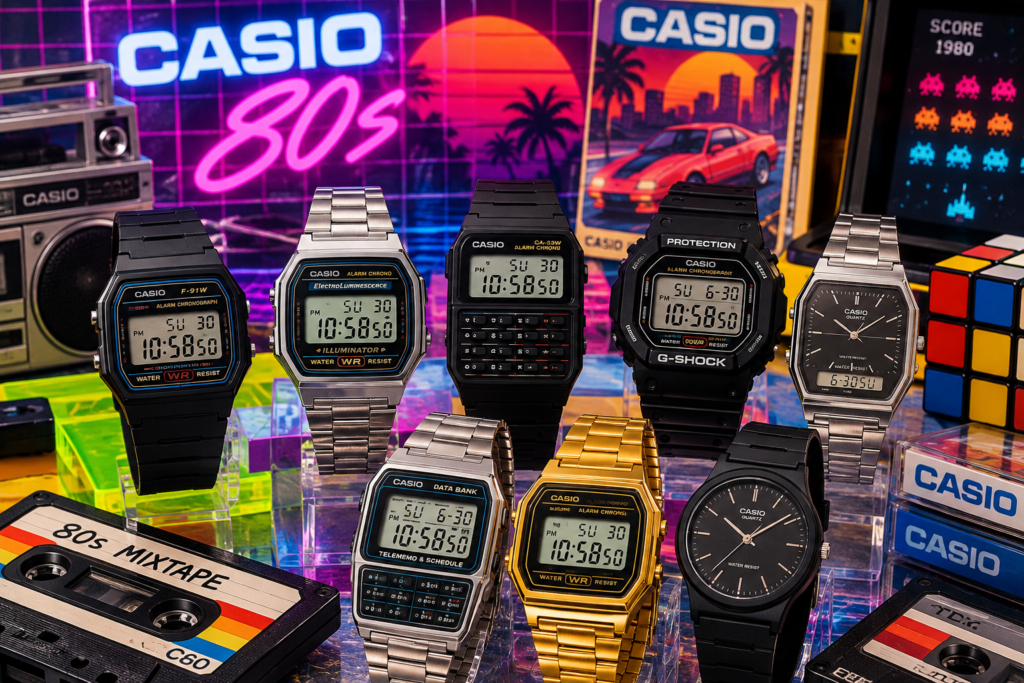
Casio’s 1980s catalogue reads like a list of ideas someone dared the engineers to put on a wrist: calculator, dictionary, data storage, solar power and a case designed to survive a fall. Not every experiment became a classic, but the decade established the two Casio personalities we still recognize—clever everyday electronics and practically indestructible G-Shock.
Start with the C-80
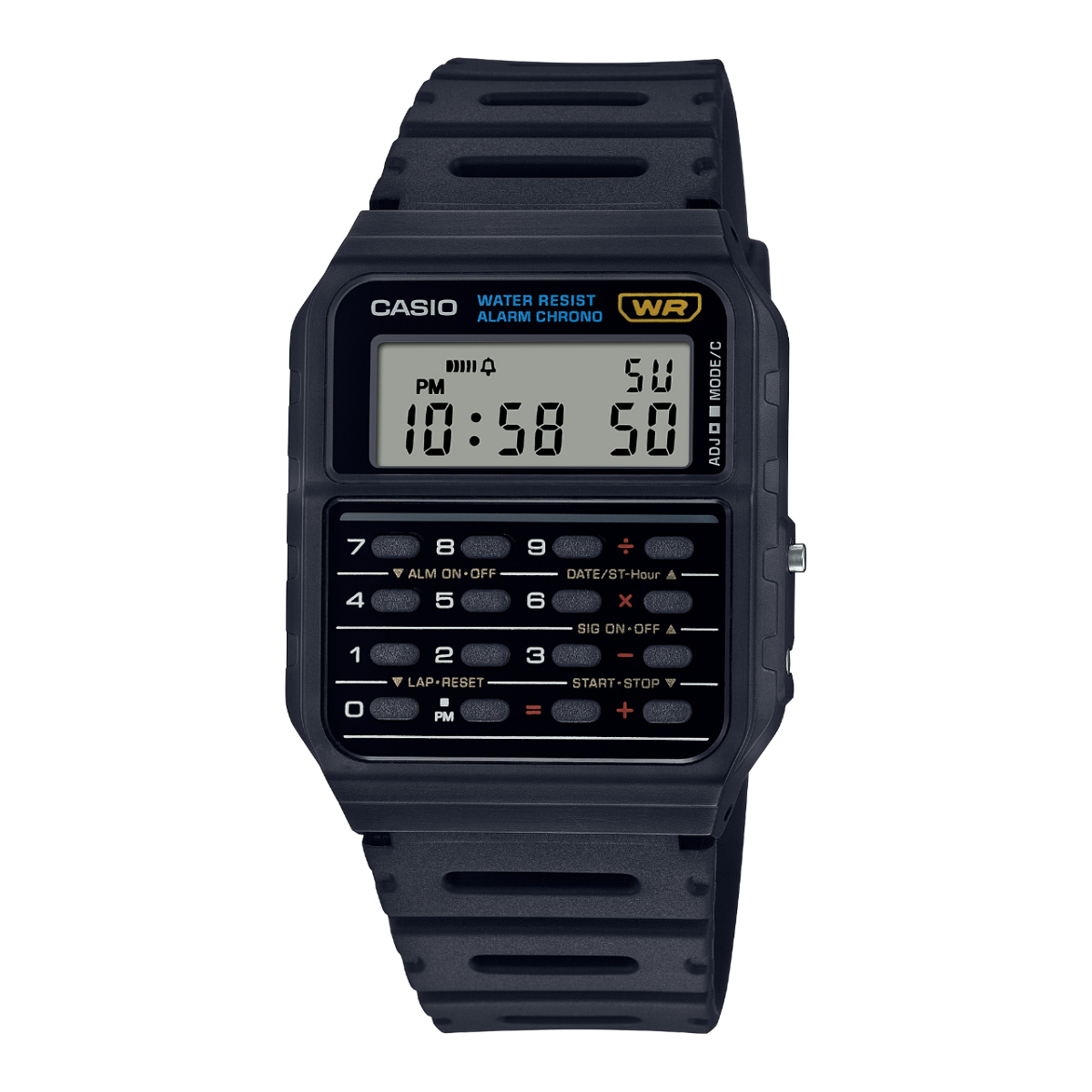
Released in 1980, the C-80 was an early calculator watch with a keypad intended for direct fingertip input and an eight-digit calculation display. Casio did not stop at simple arithmetic. The 1983 CFX-200 added scientific calculations and conversions, showing how seriously the company treated the watch as a compact tool.
The charm now is partly visual: rows of tiny buttons make a modest black watch instantly recognizable. But it is worth remembering that these functions arrived before the smartphone, and even before a pocket calculator was something everyone carried.
The 1983 watch that changed Casio
The DW-5000C, launched in April 1983, was the first G-Shock. Designer Kikuo Ibe’s team built a hollow structure that cushioned the module inside the case, then surrounded it with urethane protection. The result looked chunky beside the slim digitals of the day, but the form followed a very clear purpose.
Success was not immediate everywhere. The original G-Shock first found particularly receptive users in the United States, then grew into a global street and sports icon. The important detail for collectors is that the 1983 DW-5000C is not the same watch as today’s affordable DW-5600E, even though the family resemblance is strong.
Reference: Casio corporate history.
Data Bank, combination displays and stranger ideas
Casio’s Data Bank line moved from calculation to memory: names, telephone numbers and appointments could travel on the wrist. The DBC models with their small keyboards are the best-known descendants of that idea. Analog-digital combinations such as the AQ family offered a calmer face while keeping alarms and a second time zone in the background.
There were also wonderfully specific watches. Some tracked world time; others displayed astronomical information or included game functions. Buying one today is less about checking every feature box and more about finding a complete example whose buttons and display still work.
What to inspect on a vintage Casio
- LCD bleed: dark patches or missing segments are more serious than a weak battery.
- Button response: test every key, especially on calculator and Data Bank models.
- Resin condition: an original bezel can crumble after decades; replacements vary in quality and fit.
- Case-back and module number: use both to identify the watch. Dial text alone is not enough.
- Water resistance: assume none until a watchmaker has tested it with fresh gaskets.
Which one should you buy?
Casio’s 1980s watches remain fun because they were not designed as nostalgia. They were sincere attempts to make a wristwatch do more. That optimism survives even when the calculator keys are too small and the appointment memory is less convenient than a phone.