
A digital watch in the 1980s could be a calculator, an alarm clock, a stopwatch, a game console or a piece of sports equipment. Sometimes it tried to be several of those things at once.
That is what makes 80s digital watches more interesting than the generic “retro LCD watch” aesthetic sold today. By the beginning of the decade, digital timekeeping itself was no longer enough to impress people. Manufacturers had to find new things to put on the wrist.
Casio added calculators, phone-number storage, games and extreme durability. Timex built a digital watch specifically around triathlon. Nelsonic squeezed arcade characters onto tiny LCDs. Even the basic steel-bracelet digitals that survived the period became part of a design language that is still immediately recognizable.
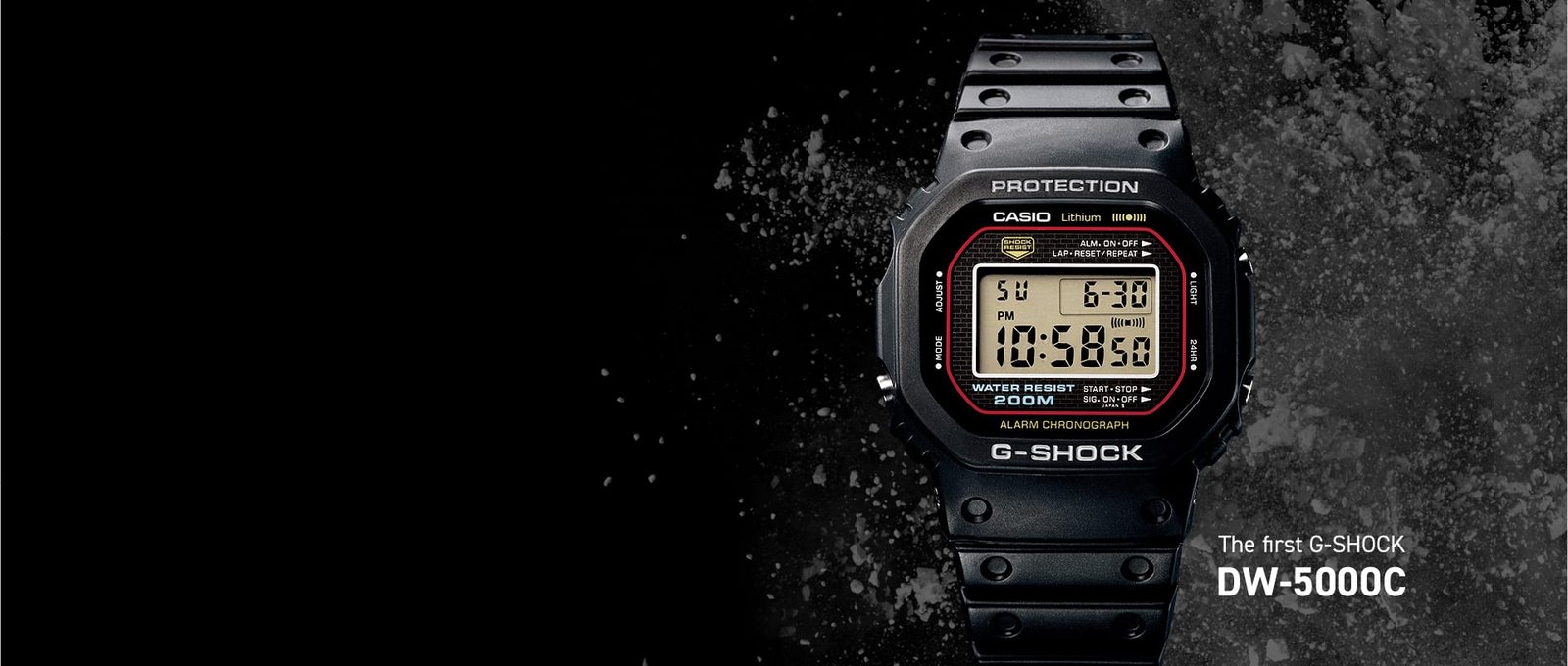
And in 1983, Casio introduced the DW-5000C, turning the digital watch from a relatively delicate electronic gadget into something designed specifically to take abuse.
The Digital Watches That Defined the 1980s
There were hundreds of references, so a useful list needs to represent the different directions the industry was taking rather than simply collect every Casio released during the decade.
| Watch / Family | Year | What Made It Interesting |
|---|---|---|
| Casio C-80 | 1980 | Calculator built directly into the watch |
| Casio GM-10 | 1980 | Early animated game watch with alien shoot-em-up |
| Nelsonic Game Watches | 1981 onward | Arcade and pop-culture games in watch form |
| Casio DW-5000C G-SHOCK | 1983 | Shock-resistant digital watch |
| Casio CD-40 | 1984 | Stored telephone numbers |
| Timex Ironman Triathlon | 1986 | Purpose-built digital sports watch |
| Casio DW-5600C | 1987 | Established the long-running 5600 G-SHOCK line |
| Casio DW-500C | 1988 | Smaller G-SHOCK and precursor to BABY-G |
| Casio AW-500 | 1989 | First analog-digital G-SHOCK |
| Nelsonic Nintendo watches | 1989 onward | Licensed Nintendo games on the wrist |
Not all of these were equally successful, and some are far easier to own today than others. Together, though, they show how quickly the category was changing.
Casio C-80: A Calculator on Your Wrist
Casio started the decade with exactly the sort of product that made digital watches exciting.
The C-80 arrived in February 1980 with a built-in calculator. The idea sounds almost quaint today, but the appeal wasn’t difficult to understand in 1980. Pocket calculators had already demonstrated how useful compact electronics could be. Shrinking that functionality enough to put it on your wrist made the watch feel like another step toward personal computing.
The compromises were obvious. Tiny buttons aren’t an especially pleasant way to perform calculations. You wouldn’t choose one over a phone today for actual arithmetic.
But practicality isn’t the only reason these watches remain interesting. Calculator watches captured an era when adding another electronic function to your wrist still felt genuinely futuristic. That aesthetic eventually became so recognizable that calculator watches survived long after their technological novelty disappeared.
Casio Game Watches: When Telling Time Wasn’t Enough
Calculator functions were sensible. Putting a video game into a watch was considerably less sensible, which is precisely why the result is so memorable.
Casio experimented heavily with game watches during the 1980s. The GM-10, released in 1980, was Casio’s earliest animated game watch. Using two pushers on the right, you maneuvered a ship and fired missiles to fend off an alien attack. Models like the GD-8 Car Race and CA-90 followed, combining normal digital-watch functions with simple LCD games involving racing, shooting and other arcade-like concepts.
Calling these games “video games” requires some perspective. The displays were tiny. Animation was extremely limited. Controls were basic. Gameplay couldn’t approach an arcade cabinet or home console.
That didn’t really matter. The novelty was having a game on your wrist. For a child in the 1980s, that was a much bigger deal than comparing frame rates or screen resolution.
Today, original Casio game watches are among the more interesting branches of vintage digital-watch collecting because many of the concepts simply disappeared from the company’s mainstream catalog.
The Casio DW-5000C Changed What a Digital Watch Could Be
If I had to choose one digital watch that mattered most during the decade, the Casio G-SHOCK DW-5000C would be difficult to beat.
It arrived in April 1983. Casio engineer Kikuo Ibe wanted to create a watch that wouldn’t break when dropped. Development began with Project Team Tough in 1981, followed by more than 200 prototypes before the team arrived at the shock-resistant structure used for the first G-SHOCK.
The resulting DW-5000C used a hollow case structure that allowed the module to sit protected inside the case, along with urethane surrounding the exterior. Casio rated it to 200 meters of water resistance.
This was very different from adding another button or calculator function. G-SHOCK challenged the assumption that an electronic wristwatch needed to be treated delicately.
That idea turned out to have enormous staying power. Modern G-SHOCKs look very different from one another, but Casio still describes the DW-5000C as the origin of the entire family.
Was the first G-SHOCK immediately popular?
Not everywhere. Casio says the unusual appearance initially found stronger acceptance in markets such as the United States. Wider worldwide popularity came later as fashion changed and consumers began looking differently at the design.
That’s an important distinction when talking about digital watches from the 80s. A historically important watch wasn’t necessarily the watch everybody was wearing the moment it appeared.
Casio CD-40: Your Phone Book on Your Wrist
Before smartphones stored thousands of contacts, remembering telephone numbers was an actual problem.
Casio had an answer. The CD-40 Data Bank watch appeared in 1984 and could store telephone numbers.
This is where digital-watch history starts looking increasingly like the early history of wearable computing. Timekeeping was almost becoming the default application running underneath everything else.
The useful part wasn’t that a digital watch could display hours and minutes. Cheap digital watches could already do that perfectly well. The selling point was the additional information you could carry with you.
Casio would push the Data Bank concept much further in later years, but watches such as the CD-40 show that the basic idea was already established by the middle of the 1980s.
Nelsonic Put Pac-Man and Nintendo on the Wrist
Casio wasn’t alone in experimenting with 80s game watches.
Nelsonic Industries became particularly associated with the concept. Its watches combined an LCD time display with simple electronic games. The company obtained licenses for recognizable properties, including arcade and game franchises, turning the watch into something closer to a toy that also happened to tell time.
Pac-Man was particularly well suited to the idea. The original arcade game already relied on simple, instantly recognizable graphics. A severely simplified LCD interpretation could still communicate the basic theme even on a tiny watch display. The Pac-Man Game Watch retailed for between $25 and $35 and sold over 500,000 units.
Nelsonic later obtained Nintendo licensing. A Super Mario Bros. Game Watch appeared in 1989, followed by The Legend of Zelda and additional Nintendo-related watches around the transition into the 1990s.
The gameplay hasn’t aged particularly well. That’s not why people collect them.
An original game watch sits at the intersection of several collecting categories: vintage watches, early handheld electronics, arcade memorabilia, Nintendo collectibles, and 1980s pop culture. That crossover makes them much more interesting than their primitive specifications suggest.
Nintendo Game & Watch: Important, but Not Actually a Wristwatch
This distinction is worth making because the names are easy to confuse.
Nintendo’s Game & Watch series launched in 1980 and combined an LCD game with a clock. It became hugely successful and continued into the early 1990s.
But a standard Nintendo Game & Watch was a handheld electronic game, not a wristwatch. Nelsonic’s Game Watch products were actual watches worn on the wrist.
The names are almost identical, and both combine timekeeping with games, so vintage listings and casual discussions sometimes blur them together. If you’re specifically collecting video game watches from the 80s, that distinction matters.
Timex Ironman Triathlon: Digital Goes Running
Not every digital watch needed a gimmick.
The Timex Ironman Triathlon grew out of the Timex Triathlon, which was first sold at the Hawaii Ironman in 1984 for $34.95. The partnership with Ironman was formalized in 1986, and the watch became the best-selling watch in the United States within a year of its release.
This represents another major branch of 1980s digital-watch development.
Instead of asking: What extra gadget can we put in a watch? the design question became: What information does an athlete actually need on the wrist?
Digital displays were particularly well suited to timing. Chronographs, alarms, lap information and clear numerical displays were genuinely useful rather than decorative. The watch was developed with input from athletes like Mary Decker-Slaney and Alberto Salazar, who stressed the importance of lap splits for interval training.
The Ironman formula survived because the basic idea was good. A game watch became obsolete when handheld gaming improved. A calculator watch became unnecessary once better calculators and phones were everywhere. A lightweight watch that times a run still makes sense.
DW-5600C: The G-SHOCK Square Takes Shape
The first G-SHOCK is historically important, but another model arguably had a greater influence on the visual identity most people now associate with the square G-SHOCK.
The DW-5600C arrived in 1987 as the first model in the 5600 line. Casio says it retained the form of the original DW-5000 and remained on sale for nine years before the EL-backlit DW-5600E succeeded it in 1996.
The family resemblance to modern square G-SHOCKs is immediate. That’s unusual for consumer electronics.
Put a computer or mobile phone from 1987 next to its modern equivalent and the difference is enormous. Put a DW-5600C beside one of today’s traditional square G-SHOCKs and the relationship is obvious. The design solved its original problem well enough that it didn’t need to be reinvented every few years.
DW-500C: A Smaller G-SHOCK
The G-SHOCK concept also began moving beyond the original dimensions.
Casio introduced the DW-500C in 1988, essentially downsizing the rugged concept while preserving the functionality and appearance of the larger DW-5600C. Casio now describes it as the origin or pioneer of the later BABY-G idea.
BABY-G itself belongs to the 1990s, so the DW-500C shouldn’t be mislabeled as a 1980s BABY-G. It’s better understood as an important predecessor. That’s exactly the sort of detail worth checking when shopping for vintage watches. Modern product families don’t always line up neatly with the names used when the original watches were released.
AW-500: G-SHOCK Adds Analog Hands
Digital watches dominated early G-SHOCK, but Casio started challenging that formula before the decade ended.
The AW-500 arrived in 1989 as the first analog-digital G-SHOCK. Casio developed a shock-resistant structure that allowed the analog movement to effectively “float” and absorb impacts while maintaining 20-bar water resistance.
This model sits slightly outside the strictest definition of an all-digital watch because it combines hands with a digital display. It’s still important to the story. By 1989, digital technology no longer required abandoning traditional hands entirely. Manufacturers could combine the two formats and use each for what it did well. Analog-digital watches would become a huge part of Casio’s later catalog.
What Did an 80s Digital Watch Actually Offer?
Looking back from the smartwatch era can make these watches seem primitive. They were primitive. But that’s not the same as useless.
A good digital watch could put several everyday tools on the wrist without needing a phone, network connection or rechargeable battery.
Typical functions included: time and date, alarm, stopwatch, countdown timer, dual time, calculator, telephone-number storage, game functions. Individual models varied considerably.
The most interesting part is how manufacturers approached feature expansion. Today, one general-purpose computer on the wrist can run different applications. In the 1980s, manufacturers frequently created a completely different watch for a particular problem.
Need calculations? Calculator watch. Need stored phone numbers? Data Bank. Need something nearly indestructible? G-SHOCK. Want to play Pac-Man? Someone would happily sell you a watch for that too.
Why 1980s Digital Watches Look the Way They Do
The classic image is a rectangular LCD surrounded by black plastic or a chrome-colored case. There were practical reasons for that.
LCD modules naturally encouraged rectangular layouts. Pushers needed to remain accessible around the case. Digital functions required labels explaining what those buttons did.
On complicated models, the face could become almost comically busy. Terms such as ALARM, CHRONOGRAPH, MODE, LIGHT, START/STOP, WATER RESIST weren’t hidden. They became part of the aesthetic.
That utilitarian labeling is one reason an authentic 1980s digital watch often looks different from a modern fashion watch trying to imitate one. The old design wasn’t trying to appear retro. It was simply explaining itself.
Were 80s Digital Watches Cheap?
Many were intended to be affordable consumer electronics, but treating the entire category as disposable would be misleading.
The decade included basic digitals, advanced multifunction watches, sports watches, expensive technological experiments and the increasingly rugged G-SHOCK family. Original retail prices also varied by market and year.
For vintage shopping today, original price isn’t particularly useful on its own anyway. Rarity has changed. Some watches that were once ordinary are difficult to find intact. Others have been continuously reissued or have close modern descendants, making an original far less necessary. A strange game watch can now be more difficult to replace than a historically more important design.
Buying an Original 80s Digital Watch Today
The biggest mistake is assuming that a simple quartz movement means there is nothing to worry about. Mechanical watches and old digital watches simply fail differently.
Check every LCD segment
A photograph showing the current time isn’t enough. Look for missing segments, faded sections, black spots, poor contrast, bleeding, moisture damage. If the watch has multiple modes, ask to see them.
Battery leakage can kill an otherwise good watch
An old battery left inside for years can corrode contacts and circuitry. A clean-looking case doesn’t tell you what happened inside it. Ask whether the battery compartment has been inspected.
Original resin can become brittle
This is particularly relevant to early G-SHOCKs. A bezel or strap can look acceptable in a photograph and begin cracking once handled. Original resin is attractive from a collector’s perspective, but replacement exterior components may make more sense if the watch is intended for regular wear.
Complicated watches need complicated testing
If you’re buying a game watch, test the game. If you’re buying a calculator watch, test the keypad. If it’s a Data Bank, verify that the storage functions work. A rare multifunction watch that only tells time isn’t necessarily a fully functional example.
Forget the original water-resistance rating
The DW-5000C was originally rated to 200 meters. That doesn’t mean a surviving 1983 example should be taken swimming today. Seals age. Cases are opened. Gaskets are replaced incorrectly or not replaced at all. Unless a vintage digital watch has been appropriately inspected and pressure-tested, treat its original water-resistance specification as historical information.
Original 1980s Watch or Modern Reissue?
This is where I wouldn’t automatically choose vintage.
If you want the look of an old square G-SHOCK for everyday use, a modern descendant is usually easier to own. Casio still produces watches based closely on the design principles established by the original DW-5000C and 5600 family. The same logic applies to simple retro digitals.
Vintage becomes more compelling when the original watch does something that modern replacements don’t reproduce. An unusual calculator reference, game watch, early Data Bank or original 1980s G-SHOCK has historical interest that a new retro-styled watch can’t provide.
My dividing line would be simple: Buy modern if you mainly want the design. Buy vintage if you specifically want the technology and object from the period.
Which 80s Digital Watches Are Most Interesting to Collect?
I wouldn’t build the collection around price. I’d build it around the different ideas competing during the decade.
A Casio DW-5000C or DW-5600C represents toughness. A calculator Casio represents wearable utility. A Data Bank represents personal information moving onto the wrist. A Timex Ironman represents digital watches becoming serious sports tools. A Nelsonic game watch represents the strange overlap between watches, toys and video games.
Those five directions tell the story of the decade better than a box containing ten nearly identical stainless-steel LCD watches.
And if I were choosing only one model for historical significance, the DW-5000C would be difficult to argue against. The G-SHOCK concept that started with it in 1983 is still alive more than four decades later.
FAQ
What digital watches were popular in the 80s? Casio was one of the most important manufacturers, with calculator watches, Data Bank models and the emerging G-SHOCK family. Timex also became significant in sports watches with the Ironman Triathlon, while Nelsonic became known for game watches based on arcade and video-game properties.
When did G-SHOCK come out? The first G-SHOCK, the Casio DW-5000C, was released in April 1983. It used a shock-resistant construction developed by Kikuo Ibe and Project Team Tough.
Were there video game watches in the 1980s? Yes. Casio produced several watches with simple built-in LCD games, including the GM-10 in 1980 and the CA-90/CA-901 in 1981. Nelsonic developed dedicated Game Watches and licensed properties including arcade games and, by the end of the decade, Nintendo franchises.
Did Nintendo make a watch in the 80s? Nintendo’s famous Game & Watch products launched in 1980, but they were handheld LCD games with clocks rather than conventional wristwatches. Nelsonic later produced actual Nintendo-licensed game wristwatches, including Super Mario Bros. in 1989.
What was the first calculator watch of the 1980s? Casio’s C-80 was released in February 1980 with a built-in calculator. Calculator watches existed before 1980, however, so it should not be described as the world’s first calculator watch.
Are 80s digital watches collectible? Yes, although collectibility varies enormously. Early G-SHOCKs, unusual Casio game watches, Data Bank models and licensed Nelsonic Game Watches can be particularly interesting. Condition matters because LCDs, resin components, buttons and battery compartments can deteriorate with age.
Can you still wear a digital watch from the 1980s? A working example can certainly be worn, but check the LCD, buttons, battery compartment, case and strap first. Don’t assume the original water-resistance rating remains valid. For everyday wear, a modern descendant is often the more practical option; for collecting the actual technology of the period, the original is much more interesting.