
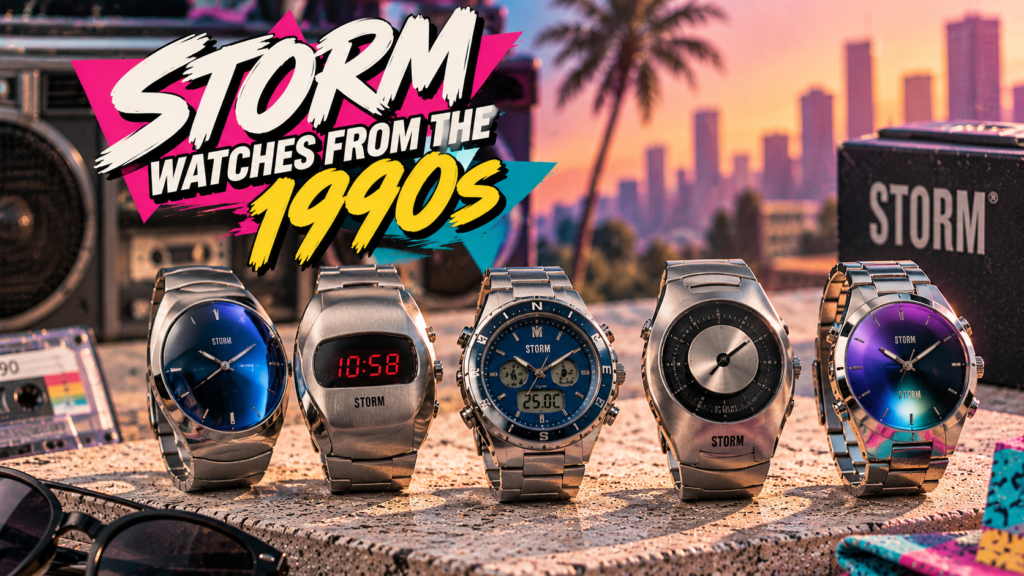
STORM started in London in 1989 with no watchmaking history to protect. That turned out to be an advantage. While established brands sold tradition or affordability, STORM sold shape. Sculpted metal cases, domed glass, iridescent dials, rotating discs, hidden LED displays. The watch didn’t have to look like a watch everyone had already seen.
Today these watches sit in an odd corner of collecting. They aren’t luxury pieces. Most weren’t meant to be. They’re artifacts from a young British fashion brand that treated the wrist as a place to experiment.
What 90s STORM Watches Actually Looked Like
There was no single STORM case shape, and that inconsistency is the point. Two watches with the same logo can look like they came from different companies.
| Feature | Typical STORM Approach |
|---|---|
| Cases | Sculpted, curved, unconventional |
| Materials | Stainless steel, heavy glass, mixed metals |
| Dials | Minimalist or deliberately strange |
| Colors | Blue, green, purple, reflective finishes |
| Crystal | Domed, raised, unusually shaped |
| Displays | Analog, LED, rotating discs |
| Bracelets | Integrated-looking metal designs |
| Functions | Dual time, sensors, gadget features |
The bracelet usually wasn’t an afterthought. On many models it looks built into the case rather than attached to it. That creates a practical problem today: a missing link is harder to replace than you’d expect, because a generic leather strap won’t preserve the original look.
Lazer Blue Was the Signature
The easiest way to spot a STORM is the dial color. The company’s Lazer Blue glass shifts appearance depending on light and angle. Under one source it looks intensely blue. Move it slightly and the color changes.
That effect suited STORM perfectly because the dial itself was often the main visual feature. It also means you should be cautious judging a vintage STORM from a single marketplace photo. Two images of the same Lazer dial can look like two different watches.
The Models Worth Knowing
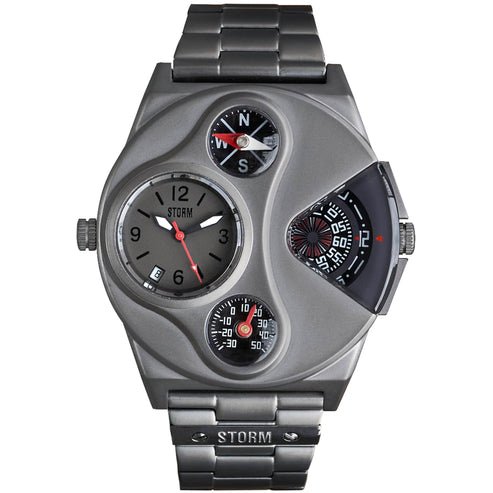
Navigator
The Navigator is one of STORM’s most recognizable designs, and the company has confirmed the original launched in the 1990s. The modern V2 Navigator is a direct remake. The original concept was simple: an unusual metal case with a gadget loadout. Dual time, thermometer, compass, date. Not a minimalist watch. The point was having something on your wrist that made people ask what it did.
Hemisphere (1997)
A transparent ring surrounds a silver central hemisphere, and the center rotates with the seconds. Thick domed glass adds another optical layer. Nothing about this is useful in a traditional sense. The mechanism exists because watching part of the dial move is interesting. STORM did this repeatedly: make time move differently instead of relying on three conventional hands.
Digicom (1998)
A reflective oval window sits in a curved metal case. Press a button and a four-digit LED display appears behind it. One button for time, another for date. Switched off, it photographs poorly. You could mistake the reflective section for decoration. Activate it and the object suddenly makes sense.
Force Curvex (1999)
STORM has retained some original watches in its archive, and the Force Curvex is one of them, explicitly dated to 1999. The archived example includes its original tin, care leaflet, display stand, and a signed certificate. Brushed stainless steel, prominently domed glass. This matters because marketplace dating is unreliable. An archive piece with a confirmed year gives you an actual reference point.
Darth
The Darth uses STORM’s revolving-disc mechanism for hours and minutes, plus a multicolored seconds counter. Brushed stainless steel case and bracelet, elevated cut-glass dial. Verify the production date on any specific vintage example rather than assuming every Darth is from the 90s.
STORM Wasn’t Competing With Rolex
This matters when evaluating these watches today. A 1990s Rolex sold continuity. A Submariner was recognizable because it preserved a design language built over decades. STORM was new. Its advantage was novelty. The company could make a curved metal watch with a blue reflective dial and a strange display without worrying that collectors would complain it no longer looked like a 1960s model.
STORM’s own description of the brand emphasizes inventive design and experimentation with materials rather than watchmaking heritage. That’s the right framework for judging these watches.
How to Identify One
Start with the case back. STORM’s service documentation says the model name is engraved there, usually above the logo. The company’s instruction archive lists a surprising number of model names, including Navigator, Digicom, Digithon, Hydroxis, Darth, Circuit, and others.
For older examples, documentation is incomplete. Use several pieces of evidence: model name, case-back markings, movement, original tin, instruction leaflet, period advertisements, archived STORM listings. Don’t rely on an eBay title. Marketplace searches contain dozens of watches sellers categorize as 1990-1999 STORM pieces, but seller-selected dates aren’t manufacturer documentation. If you can’t verify the exact year, “1990s STORM” is safer than inventing a precise date.
What to Check Before Buying
The glass. Domed and unusually shaped crystals are part of the attraction and something you don’t want to replace. Look for chips, deep scratches, cracks, edge damage, clouding underneath. A generic flat replacement destroys much of what made the design interesting.
The Lazer dial. Ask for several photos in different light. An iridescent dial naturally changes appearance. More importantly, check for moisture damage or deterioration rather than assuming every strange color is intentional.
The unusual functions. A conventional analog STORM is straightforward. A Navigator isn’t. Neither is a Digicom or anything with a rotating display. Test the feature that makes the model worth buying. A broken gadget watch can still look interesting, but it should be priced accordingly.
The bracelet length. Original STORM bracelets are often integral to the design. Missing links aren’t easy to replace. Ask for the maximum wearable wrist circumference before buying.
The battery compartment. “Needs a battery” isn’t enough. Old batteries leak and damage contacts. Ask whether the watch has been opened and inspected.
Water resistance. STORM currently recommends resealing and testing a watch every year or whenever the case has been opened. That advice matters more for a watch from the 1990s. A 50-meter marking describes what the watch was designed to do under the right conditions. It says nothing about decades-old gaskets. Unless a vintage STORM has been recently tested, keep it away from water.
Original or Modern Remake?
STORM has revisited some of its older designs. The V2 Navigator is explicitly described by the company as a contemporary remake of the original 1990s Navigator. STORM also maintains a small Vintage section containing genuine archived pieces rather than new production. These are previously unsold watches from the company’s own archives, sometimes with age-related imperfections despite being unworn.
That gives you three options:
| Type | Best For |
|---|---|
| Original used 90s watch | Period authenticity at a lower price |
| STORM archive piece | Original vintage with stronger provenance |
| Modern remake | Easier everyday ownership |
For daily wear, the modern version makes more sense. For collecting, the original is the object that existed when the design was actually futuristic.
Are They Collectible?
Yes, but use the word carefully. These watches don’t need to become expensive to be worth collecting. Relatively accessible prices are part of the appeal. STORM offers a slice of 1990s watch design that looks nothing like another Seiko, Citizen, or Swiss dress watch.
What matters most: documented 1990s production, unusual original design, functioning special features, intact original bracelet, good crystal condition, original dial and components, original tin and paperwork, strong provenance.
“Rare” on its own doesn’t impress. A watch can be rare because nobody saved it. A distinctive, complete, documented example is more interesting.
Why They Still Work
Some 1990s products look old because technology moved past them. STORM’s best watches are different. They were strange when they were new. A thick dome of glass, a rotating disc, a tiny LED window, an intensely blue reflective dial. None of that was an attempt to create a neutral object that disappears on the wrist. It was supposed to be noticed.
That gives Storm watches from the 90s an advantage as vintage objects. Their age hasn’t accidentally made them eccentric. Eccentricity was the original idea.
If you’re choosing one, don’t search for the most expensive or mechanically sophisticated model. Find the STORM that makes the least sense by traditional watch-design rules. That’s probably the one that best represents what the company was doing.
FAQ
When did STORM watches start? STORM began in London in 1989, initially focused on watches. The company expanded into other fashion accessories as it approached the new millennium.
Were STORM watches popular in the 90s? The 1990s were the formative decade for STORM. The brand built its reputation around unconventional cases, colored and Lazer dials, sculptural forms, and gadget features. STORM still produces modern versions of some designs from that period, including the Navigator.
What are the most interesting 90s STORM watches? The Navigator, Hemisphere, Digicom, and Force Curvex represent different parts of STORM’s approach, from sensors and multiple functions to unusual glass, LED displays, and sculpted metal cases. The Force Curvex is directly documented by STORM as a 1999 model.
What is a STORM Lazer watch? STORM uses the Lazer name for its iridescent colored glass treatment. The color shifts depending on light and viewing angle. Lazer Blue became particularly associated with the brand.
How can I identify my vintage STORM watch? Check the case back for a model name and markings. STORM says model names are generally engraved above the logo on more recent watches, and its online instruction archive can help identify many named models.
Are vintage STORM watches valuable? Some unusual, complete, or well-documented models attract collectors, but age alone doesn’t establish value. Condition, exact model, functionality, originality, bracelet completeness, packaging, and provenance matter more.
Can I still wear a STORM watch from the 90s? Yes, if the movement, glass, case, and bracelet are in good condition. Have the water resistance tested before exposing an old watch to water. STORM recommends resealing and testing after the case has been opened.
Does STORM still make 90s-style watches? Yes. The company has revisited older designs, including the V2 Navigator, which STORM describes as a contemporary remake of the original 1990s Navigator. It also occasionally sells genuine unworn pieces from its archives through its Vintage collection.