

The 1980s were strange for Seiko. The company had already changed the watch industry with quartz, so making another accurate battery-powered watch wasn’t enough. Over the next ten years, Seiko pushed in several directions at once.
It put a television on a wrist. It built a watch that could record your voice. It worked with Giorgetto Giugiaro on asymmetric quartz chronographs. It created a wrist computer with a separate keyboard. At the other extreme, it developed professional dive watches rated to 1,000 meters.
Then, in 1988, it commercialized a technology that combined quartz accuracy with electricity generated by the wearer’s movement. That system later became known as Kinetic.
There isn’t one definitive 1980s Seiko. The decade contains conventional quartz watches, professional divers, and some genuinely bizarre experiments with wearable electronics.
The Seiko Watches That Defined the 1980s
These aren’t the most expensive Seikos from the period. They’re the watches that best explain what the company was doing.
| Watch | Year | Why It Matters |
|---|---|---|
| Seiko TV Watch | 1982 | First TV watch |
| Hybrid Diver’s 150M | 1982 | Analog-digital professional diver |
| Voice Note | 1983 | First watch with audio recording and playback |
| 7A28 analog quartz chronograph | 1983 | First analog quartz chronograph |
| Giugiaro Speedmaster | 1983 | Asymmetric motorsport-oriented design |
| UC-2000 | 1984 | Wrist computer with data storage |
| Professional Diver’s 1000M | 1986 | Ceramic outer case, titanium construction |
| A.G.S. 7M22 | 1988 | Motion-generated electricity for quartz |
Seiko TV Watch: A Television on Your Wrist in 1982
The Seiko TV Watch landed in Japan on December 23, 1982. It used a black-and-white LCD screen measuring just 30.5 millimeters wide. The complete system, including the receiver unit and headphones, weighed 320 grams and cost 108,000 yen, roughly $640 at the time.
The catch was that the television hardware wasn’t inside the watch. An external receiver connected by cable handled the TV and FM signals. The wrist unit displayed the image. Seiko says the watch was recognized by Guinness World Records as the world’s smallest television.
Today you can stream video to a smartwatch. Seiko was exploring the basic idea of a wearable video display more than four decades ago.
Voice Note: Seiko Put a Recorder in a Watch
In 1983, Seiko introduced the Voice Note. It could record up to eight seconds of audio and replay it later. A recorded voice could also be used as an alert at a preset time.
Eight seconds sounds ridiculous compared with a smartphone. But think about the intended use. You needed to remember a phone number or short task. Instead of finding paper, you spoke into your wrist. It was a primitive voice memo. Seiko identifies it as the world’s first watch with audio recording and playback.
The watch also appeared on the wrists of three Ghostbusters in the 1984 film, which gave it a second life as a movie prop.
1983 Also Gave Us the 7A28 Quartz Chronograph
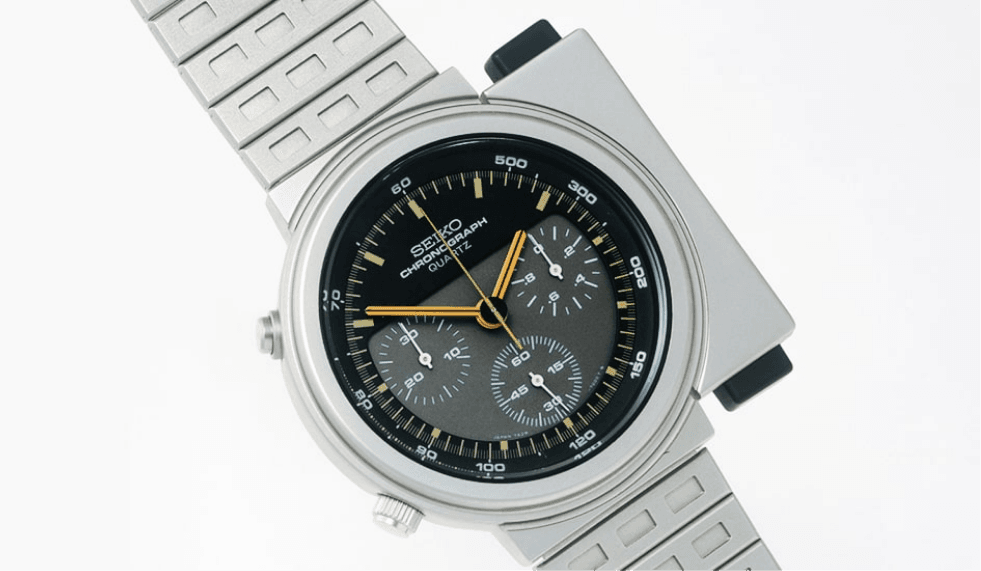
Seiko introduced what it identifies as the world’s first analog quartz chronograph in 1983. The movement could measure elapsed time to 5/100 of a second and offered split-time capability together with a tachymeter.
Collectors know the movement family as 7A28.
The 7A28 was created when quartz chronographs were still technologically interesting products rather than disposable commodity movements. A seller on WatchCharts notes that these movements “were made well, with no plastic parts, and can be serviced and regulated if needed”. That makes surviving 7A28 watches one of the more approachable ways to collect genuinely significant 1980s Seiko technology.
Giugiaro Made the 7A28 Look Even Stranger
Seiko collaborated with Italian designer Giorgetto Giugiaro, whose automotive work included cars for Alfa Romeo, Volkswagen, and Lotus. His Seiko chronographs looked appropriately automotive. Some designs shifted controls toward one side, producing an aggressively asymmetric profile.
One Giugiaro Seiko became particularly famous through cinema. A black-and-red Seiko 7A28-7000 appeared on Sigourney Weaver’s character Ellen Ripley in Aliens. Collectors call the design the Ripley.
Seiko re-released the Giugiaro 7A28-7000 as the “Seiko X Giugiaro Spirit Smart” in 2015. The new version kept the squared-off block on the right side but ditched the extra button and crown on the left. A review of the reissue noted that the case has “a very industrial feel, which, when pictured against the gloomy backdrop of Aliens makes a lot of sense”.
That’s also why you should be careful with modern reissues. A modern recreation isn’t an original 1980s 7A28. Check the actual reference and movement rather than buying from a listing that simply says “vintage Ripley.”
UC-2000: Seiko Built a Wrist Computer in 1984
The UC-2000 may be even more interesting than the TV Watch. Introduced in 1984, Seiko describes it as the world’s first wrist-type computer.
The watch could store up to 2,000 characters, including telephone numbers, addresses, and approximately one month of schedule information. But the memorable part was the system around it. The UC-2000 could connect to a separate controller with a keyboard, allowing data entry through a much more convenient interface than tiny watch buttons. A pocket-sized keyboard was also available, enabling work outside the office.
The system used wireless data transfer between components. A technical paper from the Japan Horological Society described it as the first wireless data transfer method in this field.
Calling the UC-2000 a modern smartwatch stretches the definition too far. There was no internet connection or continuous wireless synchronization. But the underlying problem Seiko was solving should sound familiar: how do we move useful information from a larger computer onto something we can carry everywhere? The same question reappeared with PDAs, Timex Data Link watches, and eventually smartphones.
Seiko’s 1980s Divers Were a Completely Different Experiment
While Seiko’s electronics division was shrinking computers onto wrists, its professional dive-watch engineers were dealing with pressure, corrosion, shock, helium, and reliability. That produced some of the most technically serious Seiko watches of the decade.
In 1986, Seiko released the Professional Diver’s 1000M. It combined 1,000-meter water resistance for saturation diving with a one-piece titanium case, quartz caliber 7C46, and a ceramic outer protector. Seiko identifies it as the world’s first diver’s watch to use ceramic for the outer case.
This wasn’t ceramic used because it looked luxurious. It was a functional material choice. The zirconia ceramic outer protector is seven times harder than steel, enhancing resistance to shock. The crown was marked with a yellow “Lock” sign so the wearer could immediately notice if it was unlocked.
The contrast with the TV Watch is almost comical. Both are Seikos from the same decade. One was trying to put television on your wrist. The other was designed to survive 1,000 meters underwater.
Why the 7C46 Movement Matters
The 1986 diver used Seiko’s 7C46 quartz caliber. Seiko’s engineering history notes that the movement maintained the high torque required to drive large, highly visible diver’s hands while increasing battery life to five years.
That’s the sort of quartz engineering that gets overlooked. A quartz movement isn’t automatically simple just because it uses a battery. Driving large hands reliably while maintaining long battery life, accuracy, and resistance to hostile conditions presents a different engineering challenge from building a cheap dress watch.
Then Seiko Tried to Eliminate Battery Changes
Quartz solved one problem and created another. Batteries eventually run out.
Seiko spent years experimenting with ways to generate electricity directly in the watch. At the 1986 Basel fair, it showed a prototype designed to convert the wearer’s movement into electrical energy. The commercially available breakthrough arrived in 1988 as A.G.S., using caliber 7M22. AGS meant Automatic Generating System.
Inside, an oscillating weight moved with the wearer and generated electrical energy. That energy powered a quartz movement. Seiko later renamed the technology Kinetic.
An AGS watch contains a rotor that moves as you wear it, much like an automatic mechanical watch. But that rotor isn’t winding a mainspring. It’s generating electricity. The timekeeping system remains quartz. Seiko had effectively asked: can we keep quartz accuracy without requiring conventional battery replacement?
Early AGS Watches Need Careful Buying Today
An original 1988 AGS isn’t necessarily the easiest vintage Seiko to own. Energy-storage components age. A watch can appear cosmetically excellent while having poor charge retention.
Before buying an early AGS/Kinetic piece, check whether it charges, whether it holds a charge, how long it runs after being worn, whether the rotor moves normally, and whether the energy-storage system has been replaced. Don’t buy one purely because shaking it makes the seconds hand move. That’s not enough to establish healthy operation.
How to Identify a Seiko Watch From the 80s
Turn the watch over. Vintage Seiko case backs normally provide important identifying information, including a caliber and case reference. You’ll commonly see a format resembling 7A28-7000. The first part identifies the movement family. The second identifies the case design.
The serial number can help establish production date, but it must be interpreted together with the model’s known production period because Seiko serial-number patterns repeat across decades. A serial number beginning with “4” does not independently prove a watch was manufactured in 1984. You need the caliber and reference as context.
Marketplace descriptions regularly contain phrases like “RARE 1980s SEIKO” or “VINTAGE SEIKO 1985.” Ignore the adjectives initially. Find the reference. Then research it. “1980s Seiko” describes a decade containing too many completely different watches to tell you much by itself.
What to Check Before Buying an 80s Seiko
A watch from 1985 is now roughly forty years old. Even quartz watches deserve proper inspection.
Battery leakage. A dead battery left inside for years can leak and damage contacts, coils, and circuit components. “Probably needs battery” should be treated as untested, not as a promise of an easy repair.
LCD condition. For digital models, inspect every segment. Look for missing segments, bleeding, weak contrast, moisture damage, and damaged polarizers. An obscure LCD module can be substantially harder to replace than a scratched crystal.
Test every function. This matters especially with the strange Seikos. A TV Watch that only displays time has lost much of what makes it interesting. The same applies to a Voice Note that can’t record, or a UC-2000 with non-functioning data features.
Chronograph reset. On a 7A28, start, stop, and reset the chronograph. Make sure the hands behave correctly. A watch displaying normal time doesn’t prove the chronograph mechanism is healthy.
Original components. Dials, hands, bezels, bracelets, and crowns matter more on collectible references. This is particularly important with desirable Giugiaro chronographs and professional divers.
Be Careful With Vintage Seiko Divers
The 1986 Professional Diver’s was genuinely engineered for 1,000-meter saturation diving. That doesn’t mean a random surviving example remains capable of it in 2026. Gaskets age. Cases get opened. Crowns wear. Crystals are replaced. Treat the original water-resistance rating as historical specification unless the individual watch has been appropriately inspected and pressure-tested.
I wouldn’t take an untested forty-year-old diver swimming simply because its dial says “Professional.”
Are 80s Seiko Watches Valuable?
Some are. Many aren’t. The decade alone doesn’t create value.
An ordinary mass-produced quartz Seiko and a complete TV Watch system are both authentic 1980s Seikos, but their collector markets are completely different. Value depends much more on exact reference, rarity, historical importance, originality, cosmetic condition, functionality, accessories, and documented provenance.
For electronic watches, functionality can be particularly important. A complicated watch with a dead proprietary module can be difficult or impossible to restore without a donor. On the other hand, I wouldn’t reject an interesting watch solely because it isn’t expensive. There are plenty of overlooked 1980s Seikos that are fun precisely because the market hasn’t turned them into trophies.
FAQ
What Seiko watches were popular in the 80s? Seiko’s 1980s catalog was extremely broad, covering conventional quartz and mechanical watches, digital models, professional divers, and experimental electronic watches. Historically important examples include the TV Watch, 7A28 analog quartz chronographs, UC-2000 wrist computer, Professional Diver’s 1000M, and early AGS watches.
Did Seiko make a TV watch in the 1980s? Yes. Seiko introduced its TV Watch in 1982 with a 30.5mm black-and-white LCD display and FM radio capability. It worked with an external receiver and was recognized by Guinness World Records as the world’s smallest television.
Did Seiko make a computer watch? Yes. The UC-2000, introduced in 1984, could store up to 2,000 characters of information including telephone numbers, addresses, and schedule data. A separate controller and keyboard could be used for data entry.
What was the Seiko Voice Note? Introduced in 1983, Voice Note was a wristwatch capable of recording and replaying up to eight seconds of audio. Seiko identifies it as the world’s first watch with an audio recording and playback function.
What is a Seiko 7A28? The 7A28 is an important analog quartz chronograph movement family introduced in 1983. Seiko identifies the watch as the world’s first analog quartz chronograph, capable of 5/100-second measurement and split timing.
When did Seiko Kinetic start? The technology appeared as a prototype in 1986. Seiko commercially launched the first watch using the system in 1988 under the name A.G.S. It used the wearer’s movement to generate electricity for a quartz movement and was later renamed Kinetic.
Are 80s Seiko watches collectible? Yes, but collectibility varies enormously by reference. Historically significant watches, unusual electronics, Giugiaro chronographs, professional divers, and complete examples with original accessories can be especially interesting. Ordinary quartz Seikos can still make excellent vintage watches, but age alone doesn’t make them rare or valuable.