
Use the vehicle year as a starting point—not as the final proof. The same model year can have a remote-head key, proximity key, or optional smart key with a different battery. Search below, compare the listed key style, and confirm the code printed on the cell before ordering.
- Select the make and model or use the free-text search.
- Enter a single model year, such as 2024.
- If more than one result remains, match the physical fob style or trim.
- Prefer a row marked Official; otherwise verify the old battery after opening the case.
Search by make, model and model year. When two batteries appear for the same vehicle, compare the key style or open the fob before ordering.
| Make | Model | Years | Generation / key type | Battery | Verification |
|---|
Database updated September 2026: 301 entries across 24 makes. Official rows link to manufacturer documentation; older reference rows are deliberately labelled rather than presented as guaranteed fitment.
Why the same vehicle can show two batteries
Automakers often offer multiple transmitters during the same model year. A keyed ignition remote and a push-button-start proximity fob may use different cells. Ford’s documentation, for example, specifies CR2450 for the 2024 F-150 push-button-start remote, while older F-150 listings can vary by transmitter style. Kia’s 2024 Sorento documentation distinguishes a CR2032 folding key from a CR2450 smart key. That is why the finder now shows key/fob type instead of hiding conflicting results.
New manufacturer-confirmed entries
| Vehicle | Battery | Official source |
|---|---|---|
| 2024 Ford F-150, Bronco and Bronco Sport | CR2450 | Ford owner manual |
| 2024 Nissan Rogue, Altima and Sentra | CR2032 | Nissan owner manual |
| 2023 Toyota Sienna Hybrid | CR2450 | Toyota owner manual |
| 2024 Hyundai IONIQ 5 | CR2032 | Hyundai owner manual |
| 2024 Kia Sorento | CR2032 or CR2450 by key type | Kia owner manual |
| 2022 Ram 1500 | CR2450 | Mopar owner manual |
What CR2032, CR2025 and CR2450 mean
The first two digits indicate nominal diameter in millimetres and the last two indicate thickness in tenths of a millimetre. A CR2032 is approximately 20 mm wide and 3.2 mm thick; a CR2025 is the same diameter but thinner. A cell that physically enters the holder is not necessarily interchangeable: incorrect thickness can create weak contact or damage the retaining clip. VL2020 is a rechargeable cell used in some sealed keys and should not be treated as an ordinary drop-in CR battery.
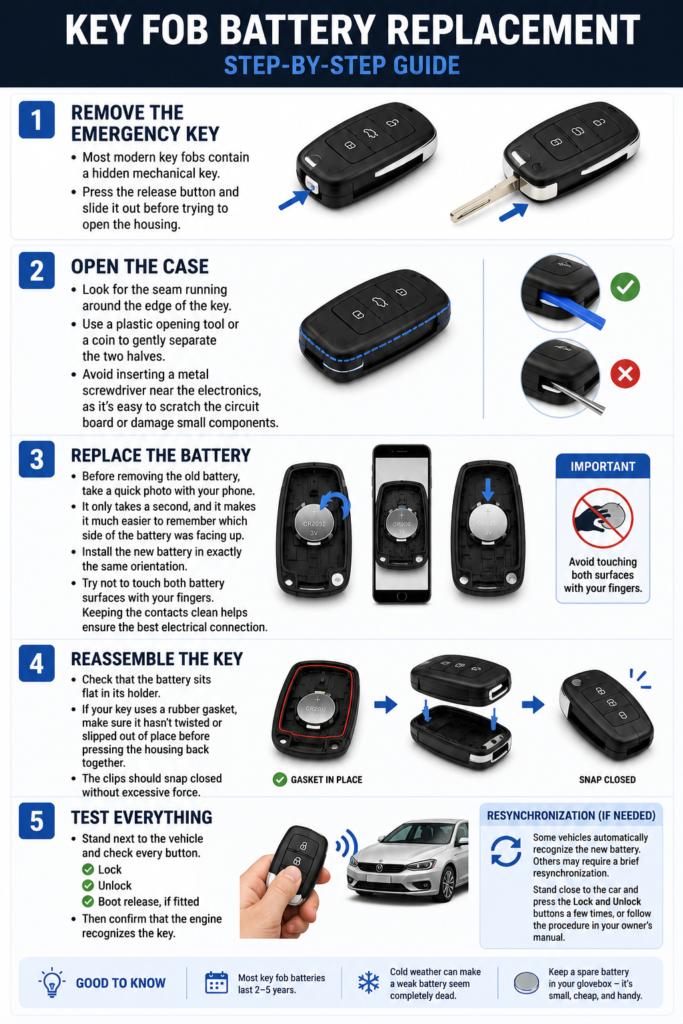
A safe five-step replacement
- Remove the emergency blade if the fob has one.
- Find the designed notch and use a plastic pick or a small flat tool wrapped in cloth.
- Photograph the old cell and its polarity before removing it.
- Hold the replacement by its edges, seat it flat, and do not bend the contacts.
- Close the case fully and test lock, unlock, trunk and remote start before leaving home.
Replacing a normal removable coin cell usually does not erase key programming. Ford explicitly states this for its current remotes. If the case contains a soldered rechargeable cell, damaged terminals, or a swollen battery, stop and use a locksmith or dealer.
If the new battery does not fix the fob
- No response: check polarity, protective stickers, battery freshness and whether the cell is fully under the retaining tabs.
- Very short range: clean the contacts, try a reputable fresh cell and move the key away from strong radio interference.
- Works only against the start button: the vehicle may be reading the passive transponder while the remote section still has no power.
- Warning returns immediately: confirm the battery thickness and key variant; inspect bent or loose contacts.
- Buttons work incorrectly: check that the rubber keypad and circuit board are seated correctly before closing the housing.
Button-cell safety
Coin cells can cause severe internal injury if swallowed. Keep new and used batteries away from children, and stop using a fob if its battery compartment will not close securely. Dispose of the old cell through an appropriate battery-recycling collection point. Toyota, Ford, Hyundai and Kia all include explicit button-cell warnings in their current owner documentation.
A battery finder gets you to the correct cell quickly, but it cannot diagnose a remote that still fails afterward. Garfind lets you compare nearby auto-electricians who can test the fob signal, receiver and vehicle battery. https://servradar.com