
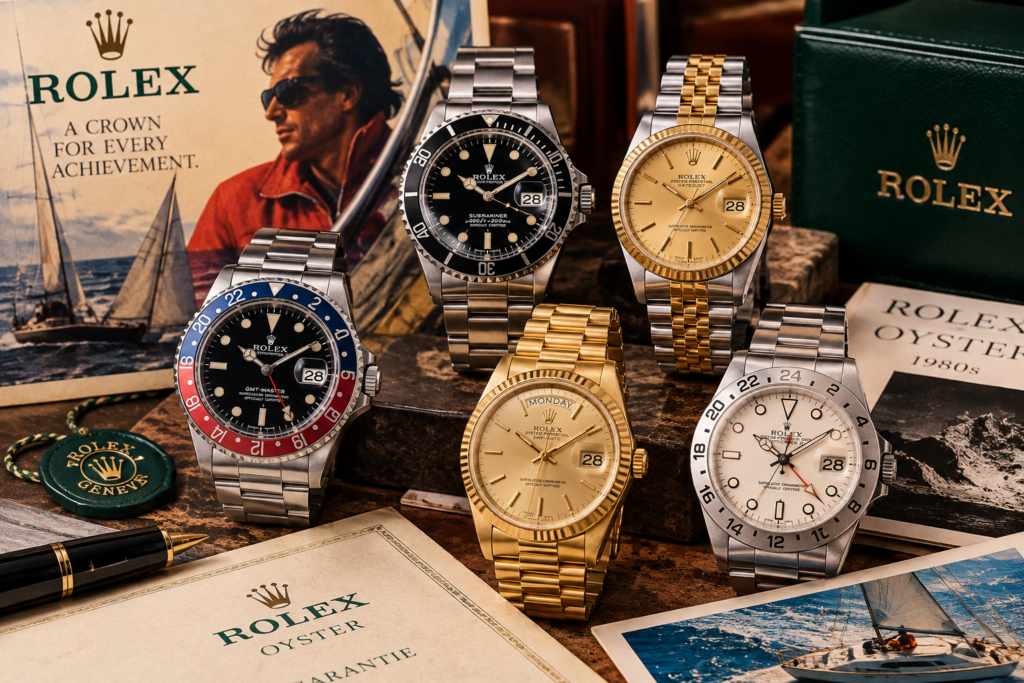
The 1980s were not a period of dramatic visual reinvention for Rolex. That is precisely why the decade matters. Familiar watches acquired sapphire crystals, quick-set dates, higher-beat movements and, in one case, a genuinely new way to use a second time zone. The result is a group of references that often look vintage but behave much more like modern watches.
GMT-Master II reference 16760: the decade’s real milestone
Rolex introduced the GMT-Master II in 1982. Its new movement allowed the conventional hour hand to jump forward or backward independently, so a traveller could change local time without disturbing the minutes or the 24-hour reference hand. The first reference, 16760, used a burgundy-and-black bezel and a thicker case that earned it the collector nickname “Fat Lady.”
This is a more meaningful distinction than bezel color. The older GMT-Master and the new GMT-Master II coexisted, but only the latter offered the independently adjustable local hour that defines the model today.
Reference: Rolex GMT-Master II timeline.
Submariner Date reference 16800
The 16800 is a classic transitional Rolex. It kept the general character of earlier Submariners while adding a sapphire crystal, a quick-set date and the higher-beat calibre 3035. Early examples used matte dials with painted markers; later ones moved to gloss dials with white-gold surrounds. That split is why two watches with the same reference can feel surprisingly different.
Condition needs to be judged as a whole. A beautifully aged dial paired with replacement hands, a much newer bezel insert and an aggressively polished case may be less coherent than a less glamorous but honest example.
GMT-Master reference 16750
For buyers who like the older GMT-Master format, the 16750 is another useful bridge. It brought a quick-set date and a faster-beat movement while retaining the acrylic crystal and slim vintage profile. As with the 16800, dial configuration and service history can matter more than a seller’s broad label of “1980s Rolex.”
Datejust reference 16233 and the two-tone look
The five-digit Datejust 16233 appeared near the end of the decade, pairing steel with yellow gold and using the calibre 3135. Fluted bezel, Jubilee bracelet and champagne dial became a shorthand for late-1980s and early-1990s success. It is also a model where over-polishing is easy to spot: soft fluting, rounded lugs and a stretched bracelet change the watch more than a few dial marks do.
Cosmograph Daytona reference 16520
In 1988 the automatic Daytona 16520 replaced the hand-wound generation. Its movement was based on the Zenith El Primero but extensively modified by Rolex, and the case grew to 40 mm. Demand later made the reference a headline collectible, but prospective buyers should focus on originality and documentation rather than assuming every variation is automatically rare.
A practical inspection list
- Start with the reference and serial range. They should make sense together before you evaluate the dial.
- Ask for movement and inside-case-back photos. Expensive watches deserve more than a front-facing glamour shot.
- Separate service parts from damage. A replacement crystal can be sensible; a mismatched dial or relumed hands materially change collectability.
- Check bracelet condition and codes. A period-correct bracelet can represent a substantial part of the value.
- Budget for independent authentication. Do it before the return period closes, not after.
What about price?
There is no useful single “1980s Rolex price.” A two-tone Datejust, an early matte-dial Submariner and a Zenith-era Daytona occupy completely different markets. Condition, dial type, completeness and service history can move the value of the same reference by a wide margin. Use recent sold results from established auction houses and dealer listings as separate data points, then compare the exact configuration—not just the model name.
For this category, anonymous marketplace listings are a poor shortcut. A good 1980s Rolex purchase should feel slow, documented and slightly boring right up until the watch arrives.