
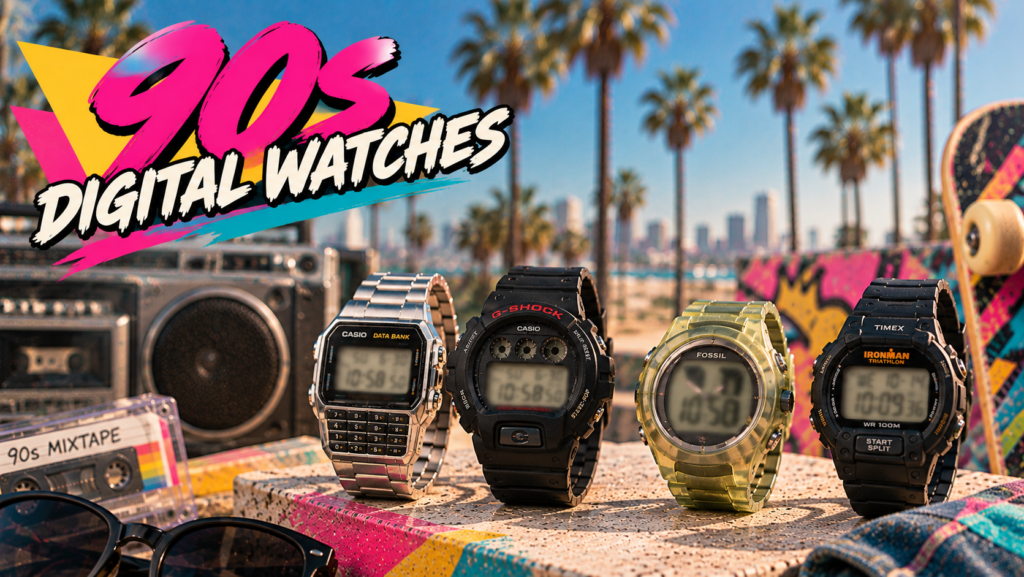
By 1990, a digital watch with an alarm, stopwatch and calendar was nothing special. Casio had already spent the 80s stuffing calculators, games and phone books onto wrists. The technology had stopped being impressive on its own.
So manufacturers went looking for the next thing. What they came up with ranges from genuinely useful to completely absurd, and that’s what makes digital watches from the 90s worth digging into. You’re not looking at better versions of 80s LCDs. You’re looking at competing guesses about what a wrist device was supposed to be.
Some of those guesses were right. Atomic time sync, solar charging, vibrating alerts. All of it exists today in better form. Others died on arrival. Pointing your watch at a computer monitor to download your schedule over flashing light is not a feature anyone brought back.
The Watches Worth Knowing
| Model | Year | What It Actually Did |
|---|---|---|
| Casio DW-5900C | 1990 | Turned G-SHOCK into a fashion object through West Coast skate culture |
| Casio VDB-1000 | 1991 | Touchscreen Data Bank with no buttons or crown |
| Casio DW-6100 | 1992 | First sensor-equipped G-SHOCK, thermometer with graphing |
| Casio DW-6300 | 1993 | First G-SHOCK diver, ISO 200m, first MASTER OF G nickname |
| Timex Data Link | 1994 | Optical data transfer from a CRT monitor |
| Casio DW-6600 | 1994 | First G-SHOCK with EL backlight |
| Casio DW-6900 | 1995 | Started the round-case family still in production |
| Casio FKT-100 | 1995 | Casio’s first radio-controlled watch, launched in Germany |
| Casio DW-5600E | 1996 | Replaced the DW-5600C, added EL backlight to the square |
| Casio VCL-100 | 1998 | Vibrated when it detected a mobile phone signal |
| Casio HBX-100 | 1998 | Infrared PC connectivity, schedules and text files |
| Casio DW-9300J | 1998 | First solar-powered G-SHOCK |
| Casio DBC-V50 | 1999 | Calculator and voice recorder in one Data Bank |
Touchscreen Before Touchscreen Was a Thing
The VDB-1000 landed in 1991 with no buttons and no crown. You touched the screen to operate it. The dot-matrix LCD showed a world map, calendar entries, addresses and world time, all through direct input.
Put it next to a smartwatch and it looks like a brick. Put it in 1991 and it’s genuinely strange. Casio wasn’t adding another feature to an existing interface. It was questioning whether the interface needed buttons at all. That question took another twenty years to get a decent answer.
G-SHOCK Stops Being Just Tough
The DW-5900C is where G-SHOCK crossed over. Casio released it outside Japan first, and it caught on with skateboarders on the US West Coast before spreading through music and street culture. The oversized resin case stopped being protective gear and started being part of the outfit.
The DW-6100 followed in 1992 with the first sensor on a G-SHOCK, a thermometer rated from -20°C to 60°C. Reading temperature off your wrist is unreliable because body heat interferes, but the point wasn’t accuracy. It was Casio testing whether a rugged digital could double as an instrument.
Then came the DW-6300 Frogman in 1993. First G-SHOCK diver, ISO-certified to 200 meters, first model to get a nickname. The asymmetric case wasn’t decoration. It gave the wrist more room to move. That 200-meter rating describes the watch in 1993, not the one in your hand today. Gaskets age.
The Square and the Round
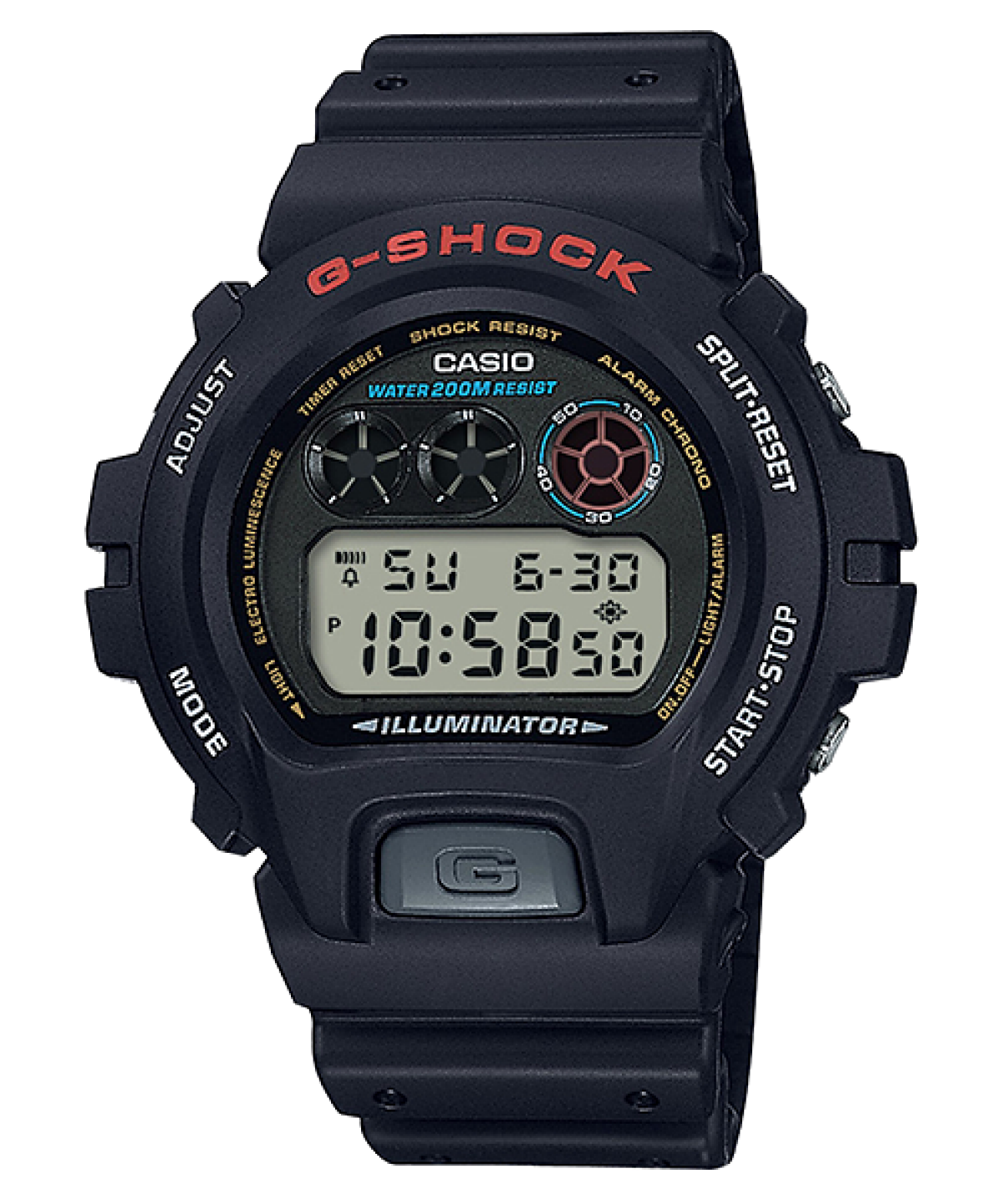
Two G-SHOCK shapes matter from this decade.
The DW-5600E arrived in 1996, replacing the long-running DW-5600C and adding an EL backlight while keeping the classic square case. Sellers blur these generations together constantly. A DW-5600C and a DW-5600E look related but aren’t the same watch historically.
The DW-6900 arrived a year earlier, in 1995. Rounded case, three circular displays, prominent front button. If you picture a round G-SHOCK, you’re probably thinking of this family. It never went out of production. Casio still builds on the same language, which creates an odd situation: an original 1995 example is interesting for collecting, but a modern 6900 gives you the same look without thirty-year-old resin.
The DW-6600 from 1994 deserves a mention here too. It was the first G-SHOCK with an electroluminescent backlight. A full-display glow sounds minor on paper. In use, it was a real improvement over the weak illumination on earlier digitals.
When Watches Started Talking to Other Things
This is where the 90s separates from the 80s. The interesting question stopped being “what can we add?” and became “what can this connect to?”
The Timex Data Link, developed with Microsoft and released in 1994, pointed your watch at a CRT monitor and let flashing patterns transfer phone numbers, appointments and to-do lists. No Bluetooth, no Wi-Fi, no background sync. You held your wrist in front of a screen and waited. Contemporary reporting in December 1994 described it as a watch that stored appointments, phone numbers and reminders. The method was awkward. The idea was not.
Casio’s FKT-100 followed in 1995 as the company’s first radio-controlled watch. An internal antenna picked up time signals calibrated by atomic clocks, letting the watch correct itself automatically. It launched in Germany first, where the signal was available. Radio-controlled timekeeping became routine for Casio later. In 1995, fitting the receiver into a wristwatch was a real engineering problem.
The VCL-100 from 1998 took a different angle entirely. It detected 800 MHz signals from mobile phones and vibrated when a call came in. Your phone might be buried in a bag where you couldn’t hear it. Your watch told you. That’s a normal feature now. The VCL-100 wasn’t connected to the phone in any structured way. It was just listening for radio activity and reacting.
The HBX-100, also from 1998, communicated with a PC over infrared. Schedules, phone directories and task lists moved between computer and watch. Text files could be viewed and edited on the wrist. Here’s the problem with buying one today: the watch may still work, but the ecosystem around it almost certainly doesn’t. Old PC software, infrared hardware, operating system compatibility. Restoring the connectivity is a much bigger project than replacing a battery.
Solar and the Long Game
The DW-9300J Raysman arrived in 1998 as the first solar-powered G-SHOCK. A solar charging system ran the electronics, and a battery indicator showed remaining charge. Casio claimed a full charge gave roughly five months of operation. The watch also had an auto-light that activated when you tilted your wrist in the dark.
Solar charging is one of the few 1990s experiments that didn’t need to be replaced by something conceptually different. It just got better. That makes the Raysman historically interesting even if it looks less futuristic than a touchscreen Data Bank.
The Voice Recording Oddity
Casio closed the decade with the DBC-V50 in 1999. Calculator, Data Bank, and a voice recorder. Five clips of up to thirty seconds each. Microphone on the front, speaker in the case back. You could set a recording as your alarm.
This is a different product from the “talking watches” that announced the time aloud, often as accessibility devices. It’s also different from character watches that played recorded phrases. The DBC-V50 recorded your voice. Whether that was essential is debatable. Casio did it anyway because nobody had decided yet what these devices should be.
What Changed Between the 80s and 90s
The 1980s gave us calculator watches, game watches, early Data Banks and the birth of G-SHOCK. The focus was on adding functions.
The 1990s shifted toward connectivity. How could the watch interact with something else? A computer, a radio signal, another watch, a phone, the environment.
The Timex Data Link received information from a monitor. The FKT-100 received time signals. The VCL-100 reacted to phone transmissions. The HBX-100 talked to computers over infrared.
None of these were smartwatches in the modern sense. But the industry was clearly moving toward the idea that a wristwatch didn’t have to be an isolated device. That shift is what makes the decade worth studying.
Buying One Today
Quartz watches survive for decades, but “quartz” doesn’t mean “nothing can go wrong.”
Check every LCD segment. Ask for photos of every display mode, not just the time screen. Look for missing segments, fading, black patches, moisture damage. A dot-matrix display deserves extra scrutiny.
Don’t believe “just needs a battery.” Maybe it does. Maybe the previous battery leaked and corroded the movement. An untested watch should be priced like an untested watch.
Test the feature that makes the model special. If you’re buying a DW-6600, check the EL backlight. If it’s a sensor model, check the sensor. If it’s a voice watch, test the audio. A rare digital that only tells time has lost most of what made it interesting.
Inspect old resin carefully. Vintage G-SHOCK bezels and straps become brittle. The module can work perfectly while the exterior crumbles. Replacement resin makes a watch wearable again but affects originality.
Assume water resistance is gone. A vintage Frogman met ISO standards for 200 meters in 1993. That says nothing about its seals today. Battery changes require opening the case, and you don’t know how previous owners treated the gaskets. If you plan to swim with an old digital, have it inspected and pressure-tested first.
Original or Modern?
For daily wear, modern usually wins. If you want the shape of a DW-6900 or a square 5600, there’s little reason to expose a clean vintage example to sweat and knocks every day. Modern G-SHOCKs preserve these designs with fresh resin, seals and electronics.
Vintage makes sense when the specific historical reference matters. An original DW-5900C tells part of the story of G-SHOCK entering street culture. A DW-6300 represents the beginning of Frogman. A Raysman represents the arrival of solar charging. Those distinctions disappear if you just pick whichever new black G-SHOCK looks similar.
What to Buy
For the pure 90s G-SHOCK look, the DW-6900 family is hard to ignore.
For early wearable computing, the Timex Data Link or Casio HBX-100 are the obvious starting points.
For strange technology, the VDB-1000 touchscreen Data Bank is more interesting than another ordinary digital.
For G-SHOCK history, the DW-6300 Frogman or DW-9300J Raysman mark real milestones.
And if the talking or voice-recording angle interests you, the DBC-V50 is the most entertaining example because the function was integrated into a Data Bank rather than tacked on as a sound effect.
The goal isn’t the longest specification list. It’s picking watches that tell different parts of the story.
FAQ
What digital watches were popular in the 90s? Casio G-SHOCK dominated, especially the DW-5900C and DW-6900, which turned the tough digital into a fashion item. The Timex Data Link was a notable early example of wrist-based computing.
What G-Shock watches came out in the 90s? The DW-5900C, DW-6100, DW-6300 Frogman, DW-6600, DW-6900, DW-5600E and solar-powered DW-9300J Raysman are the ones that matter most.
Were there smartwatches in the 1990s? Not in the modern sense. But the 1994 Timex Data Link could receive information from a PC, and Casio’s 1998 HBX-100 used infrared to exchange schedules, phone numbers and text.
Did 90s digital watches have touchscreens? Yes. The Casio VDB-1000 from 1991 used a touchscreen interface with no buttons or crown. Functions were controlled through the display itself.
Were there talking watches in the 90s? Yes, but the term covers different products. Some announced the time aloud, often for accessibility. Some character watches played recorded phrases. The Casio DBC-V50 from 1999 recorded voice memos, which is a different function entirely.
Are 90s digital watches collectible? They can be, especially when a model represents an important technology or design milestone. Early Frogman references, unusual Data Bank models, Timex Data Link watches and first-generation solar G-SHOCKs have more historical interest than an anonymous basic LCD. Condition and full functionality matter more than age alone.