
In 1991, Casio released a watch with no buttons. You operated it by touching the screen. That was three years before the Apple Newton, sixteen years before the iPhone, and it came from a company best known at the time for cheap digital watches.
That’s the 1990s in one product. Casio spent the decade throwing ideas at the wall. Touchscreens, infrared messaging, voice recording, solar charging, atomic time. Most of it didn’t stick. Some of it became the foundation for what watches do now. And through all of it, the company kept selling a five-dollar digital that outlived nearly every experiment around it.
If you’re looking at Casio watches from the 90s today, that split is what makes them worth collecting. You’re not buying one era. You’re buying two: the practical everyday Casio and the one that thought a wristwatch should be a computer.
The Decade at a Glance
| Watch | Year | Family | What It Actually Did |
|---|---|---|---|
| DW-5900C | 1990 | G-SHOCK | Turned G-SHOCK into a fashion object via West Coast skate culture |
| VDB-1000 | 1991 | Data Bank | Touchscreen interface, no buttons or crown |
| DW-6100 | 1992 | G-SHOCK | First sensor-equipped G-SHOCK, temperature with graphing |
| DW-6300 | 1993 | G-SHOCK Frogman | First G-SHOCK diver, first nicknamed MASTER OF G model |
| DW-520 | 1994 | BABY-G | First BABY-G, smaller case, fashion-first positioning |
| DW-6600 | 1994 | G-SHOCK | First G-SHOCK with EL backlight and front light button |
| JG-100 | 1994 | Cyber Cross | Infrared messaging and multiplayer gaming between wearers |
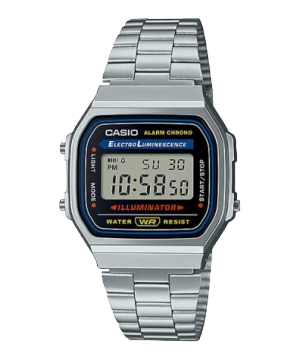
| A168 | 1995 | Digital | Simple metal-band digital that outlasted nearly every experiment |
| DW-6900 | 1995 | G-SHOCK | Started the round-case 6900 family still in production |
| FKT-100 | 1995 | Digital | Casio’s first radio-controlled watch, launched in Germany |
| DW-5600E | 1996 | G-SHOCK | Replaced the DW-5600C, added EL backlight to the square |
| MRG-100 | 1996 | G-SHOCK MR-G | First full-metal G-SHOCK, start of the premium MR-G line |
| DW-9300J | 1998 | G-SHOCK Raysman | First solar-powered G-SHOCK |
| HBX-100 | 1998 | Data Bank | Infrared PC connectivity, schedules and text files |
| DBC-V50 | 1999 | Data Bank | Calculator plus voice recorder, five clips of 30 seconds |
The G-SHOCK Line Grew Up
G-SHOCK existed before 1990. What changed during the decade was what Casio did with it. A tough digital watch turned into a fashion object, then a diving instrument, then a metal luxury product, then a solar-powered one. All within ten years.
DW-5900C (1990)
The DW-5900C is where G-SHOCK stopped being just a rugged tool. Casio released it outside Japan first, and it caught on with skateboarders on the US West Coast before spreading through music and street culture. The three circular graphic displays on the LCD became one of the brand’s recognizable signatures.
This is the model that showed Casio something important: people were buying G-SHOCK for how it looked, not just for what it survived.
DW-6100 (1992)
First sensor-equipped G-SHOCK. A thermo sensor displayed temperature and graphed changes over time, rated from -20°C to 60°C.
Reading temperature off your wrist is unreliable because body heat interferes. But that’s not the point. The DW-6100 was Casio testing whether a rugged digital watch could double as an instrument. Later outdoor lines pushed that idea much further.
DW-6300 Frogman (1993)
The first G-SHOCK diver, built to meet ISO standards for 200-meter water resistance. It was also the first G-SHOCK to get a nickname, which established the whole MASTER OF G naming convention that followed.
The asymmetric case isn’t just styling. Casio shaped it to give the wrist more freedom of movement. Frogman became its own enthusiast branch, and original examples attract a different collector than a standard square.
One thing to keep in mind: that 200-meter rating describes the watch when it left the factory in 1993. It says nothing about the gaskets inside a 30-year-old example today.
DW-6600 (1994)
The first G-SHOCK with an electroluminescent backlight. Pressing the large front button lit the whole display and revealed a red G graphic in the LCD.
It sounds minor on paper. In use, a full-display light was a real improvement over the weak illumination on earlier digitals. The front light button also became part of the G-SHOCK visual identity for years after.
DW-6900 (1995)
If you picture a round G-SHOCK instead of the classic square, you’re probably thinking of the 6900 family. Rounded case, prominent front button, three circular displays across the top.
The design never became obsolete. Casio still builds on the same language today. That creates an odd buying situation: an original 1995 example is interesting for collecting, but a modern 6900 gives you the same look without thirty-year-old resin and seals to worry about.
DW-5600E (1996)
The square G-SHOCK predates the decade, but this version matters. The DW-5600E replaced the long-running DW-5600C and added an EL backlight while keeping the familiar square case.
Sellers often blur these generations together. A DW-5600C, a DW-5600E, and a current square G-SHOCK look related but aren’t the same watch historically. Check the reference, not just the shape.
MRG-100 (1996)
The first MR-G. Casio wanted a full-metal G-SHOCK that still survived shocks, so it built buffering between the metal bezel and the case. That structure made a metal G-SHOCK possible.
Today MR-G sits at the top of the G-SHOCK catalog in price and materials. The MRG-100 is where that started. For anyone interested in how the brand evolved rather than just 90s nostalgia, early MR-G models are worth a look.
DW-9300J Raysman (1998)
First solar-powered G-SHOCK. The charging system ran the watch’s electronics, and the display included a battery indicator. A full charge gave roughly five months of operation.
Tough Solar is standard now. In 1998, putting a solar cell into a G-SHOCK was a genuine engineering step, and the Raysman is where that line begins.
The Data Bank Experiments
This is the part of 1990s Casio that aged into science fiction. The company kept trying to put computer functions on a wrist, and the results range from clever to completely impractical.
VDB-1000 (1991)
No buttons. No crown. The screen was the interface. The dot-matrix LCD showed a world map and handled calendar entries, addresses, and world time through touch input.
The VDB-1000 solved a problem that wouldn’t really be solved until smartwatches arrived twenty years later. Casio got there first with a bulky, dated-looking watch that now reads like someone’s 1991 idea of the future.
JG-100 Cyber Cross (1994)
Infrared communication. Two wearers could send messages and play games against each other remotely. It also had a friend registry and remote-control functions. Casio aimed it at elementary-school boys, and it caught on with kids who liked gadgets.
As a watch today, it’s hard to justify over a basic Casio. As a piece of 1990s tech, it’s more interesting than most of the decade’s actual computers.
HBX-100 (1998)
Connected to a PC over infrared. Users could move schedules, phone directories, and task lists between computer and watch, and view or edit text files on the wrist.
Not a smartwatch. No apps, no cloud, no constant connection. Infrared meant you had to point the watch at a receiver and wait. That limitation is exactly what makes it worth studying. The HBX-100 sits between standalone digitals and always-connected wearables, and it shows how uncertain that transition looked at the time.
DBC-V50 (1999)
Calculator, Data Bank, and a voice recorder. Five recordings of up to thirty seconds each. Microphone on the front, speaker in the case back. You could even set a recording as your alarm.
Recording thirty-second voice notes on your wrist was never essential. Casio did it anyway because nobody had decided yet what these devices should be.
The Simple One That Outlasted Everything
A168 (1995)
Compact digital display, metal bracelet, alarm, stopwatch, day and date, EL backlight. Compared to the touchscreen Data Banks and sensor G-SHOCKs, the A168 is almost boring.
That’s why it’s still here.
Casio built it for the North American market as a practical, good-looking digital, and the design outlived nearly every ambitious watch around it. In 2011 it received Japan’s Good Design Long Life Design Award.
If you want the look of a 90s Casio without the risk of owning a thirty-year-old electronic watch, a current A168 is the sensible route. It isn’t a vintage 1995 piece, but unlike most retro-styled products, its roots are genuine.
Fashion Enters the Picture
DW-520 BABY-G (1994)
By the mid-90s the bulky G-SHOCK look had become fashionable enough that Casio saw room for a second interpretation. BABY-G launched in December 1994 with the DW-520. Smaller case, brighter colors, interchangeable face protectors, surfing-inspired styling, aimed at young women.
The debut lineup had nine models with two-tone and half-skeleton colorways. This wasn’t a shrink-wrapped G-SHOCK. BABY-G leaned into fashion, music, and youth culture from the start, and it deserves a place beside G-SHOCK in any collection meant to represent the decade’s actual visual culture.
One Quiet Technical Milestone
FKT-100 (1995)
Casio’s first radio-controlled watch. An internal antenna picked up time signals calibrated by atomic clocks, letting the watch correct itself automatically. It launched in Germany, where the signal was available.
Radio-controlled watches became routine for Casio later. In 1995, fitting the receiver into a wristwatch was a real problem to solve. The FKT-100 looks ordinary. It isn’t.
What Made the Decade Different
The 1980s gave Casio its foundation. The 1990s is when that foundation split into separate directions.
G-SHOCK became fashion, then a diver’s tool, then a metal premium product, then solar. Data Bank watches pushed toward personal computing. BABY-G created a second audience. Radio control and solar charging quietly solved problems users hadn’t asked about yet.
And underneath all of it, Casio kept selling plain digital watches that did their job and kept selling for decades.
That mix is the actual story of the decade. Not one defining model. A company trying several futures at once.
Buying One Today
Vintage Casio is easier to buy than vintage mechanical luxury, but the problems are different.
Resin ages badly. Old bezels and straps crack, harden, and crumble. A working module doesn’t mean a wearable watch. Check around button openings, strap mounts, bezel edges, and screw points. Replacement resin solves the practical problem but kills originality on a collectible piece.
Inspect the LCD carefully. Missing segments, fading, dark patches, poor contrast, moisture damage. Ask for photos of every display mode, not just the time screen.
Test every function. A DBC-V50 that tells time but can’t record is not a working DBC-V50. Sensor watches need checking beyond basic timekeeping.
Battery leakage. A dead battery left inside for years can corrode the movement. Ask about the battery compartment and when it was last changed.
Water resistance is history, not a promise. A DW-6300 was a serious 200-meter diver in 1993. That tells you nothing about its seals today. Treat any vintage rating as a factory specification unless the watch has been pressure-tested recently.
Vintage or Modern?
Depends on the model, but the rule is simple.
For an A168 or a classic-looking G-SHOCK, buy modern if you plan to wear it. You get the look without old resin and electronics.
Buy vintage when the specific old model is the reason you’re interested. A VDB-1000, JG-100, early BABY-G, original Raysman, or DBC-V50 does something a current Casio doesn’t.
If You’re Building a Small Collection
Pick watches that represent different sides of the brand rather than five similar black G-SHOCKs.
A DW-5900C or DW-6900 covers G-SHOCK as a cultural object. The A168 covers the everyday digital that never died. A VDB-1000 or DBC-V50 captures the computer-on-your-wrist obsession. The DW-520 covers fashion. An MRG-100 or DW-9300J shows where later technologies started.
That set tells a better story than any single model.
FAQ
What Casio watches were popular in the 90s? G-SHOCK dominated, especially the DW-5900C and DW-6900, which turned the tough digital into a fashion item. The A168, BABY-G, and various Data Bank models cover the rest of the catalog.
What G-SHOCK models came out in the 1990s? The DW-5900C, DW-6100, DW-6300 Frogman, DW-6600, DW-6900, MRG-100, DW-5600E, and DW-9300J Raysman are the ones that matter most.
When did the Casio A168 come out?
- Casio built it for the North American market, and it became one of the company’s longest-running designs.
Did Casio make touchscreen watches in the 90s? Yes. The VDB-1000 from 1991 used a touchscreen with no buttons or crown. It showed a world map, calendar entries, and stored addresses.
When did BABY-G launch? December 1994, with the DW-520. Smaller case, brighter colors, aimed at young women.
Are 90s Casio watches worth collecting? Some are. Early G-SHOCK references, first-gen BABY-G, and unusual Data Bank models have real historical appeal. Condition and originality matter because resin and electronics deteriorate.
Can you wear a 90s Casio daily? Yes, if it works. Check the LCD, buttons, resin, strap, and battery compartment first. For anything involving water, a modern Casio is safer unless the vintage one has been inspected and tested.
Is a modern retro Casio the same as a 90s one? No. Some current models preserve designs from that era, but a new A168 or G-SHOCK is not a vintage watch. If you want the period, verify the reference and production details.