
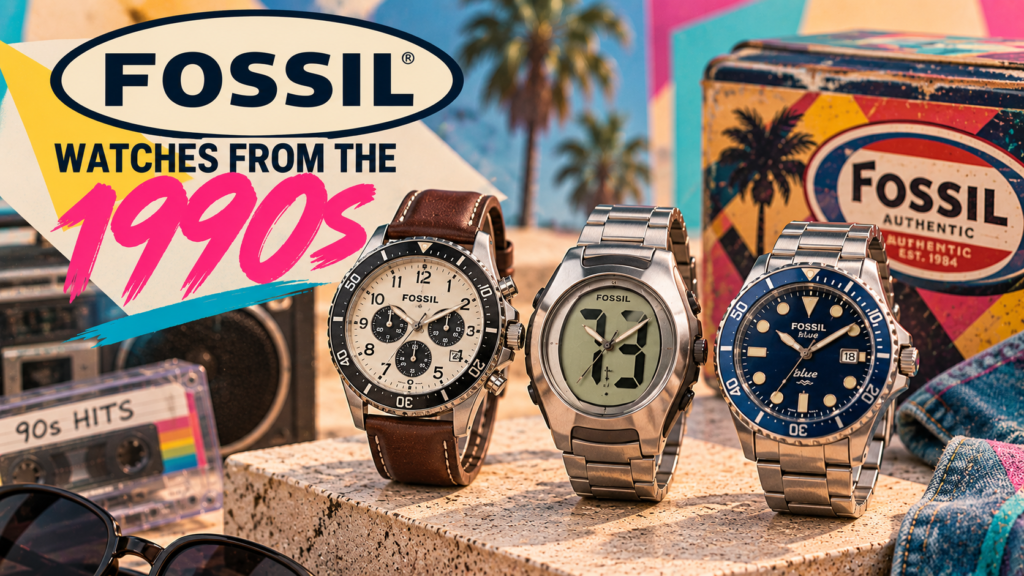
Fossil watches from the 90s are easy to dismiss. Most of them were quartz. Most sold for under $100. None of them were going to impress anyone at a watch meetup.
And yet, people still hunt for them. Not because of the movement. Because of the tins, the graphics, the weird Big Tic animation, and the fact that Fossil somehow made an inexpensive department-store watch feel like it had a personality.
That strategy worked better than anyone probably expected. Fossil went public in 1993. Sales hit $105 million that year, then kept climbing. By the mid-90s, the brand was selling watches in thousands of department stores, outlet shops, and eventually its own retail locations. Not bad for a company that started by selling vintage-look watches with retro packaging.
What Fossil Actually Was in the 90s
Fossil didn’t pretend to compete with Swiss watchmaking. The company’s own filings describe its approach as differentiating through “innovations in fashion details” — dials, crystals, cases, straps, and packaging. Movement technology wasn’t the selling point. Design and presentation were.
The tins are the clearest example. Fossil started packaging watches in decorated metal boxes in 1989, using graphics inspired by 1950s Americana. It sounds like a minor detail. In practice, those tins became part of the product. People kept them. Collectors still look for them. WorthPoint notes that watches complete with their original tin or wooden box usually hold more value than the watch alone.
| What Fossil Sold in the 90s | Why It Mattered |
|---|---|
| Classic quartz dress watches | The everyday product; leather straps, simple dials, nothing flashy |
| Chronographs | Added visual complexity without expensive mechanical movements |
| Fossil Blue sport models | Dive-watch styling at an accessible price; steel cases, bold dials |
| Big Tic (from 1998) | Analog hands over an animated LCD; genuinely distinctive |
| Hologram watches (1992) | Eight models launched at once, priced at $60 |
| Limited editions | SK 5038 in March 1992 started the run |
| Defender series (mid-90s) | Higher-end line with DE and DF models; some retailed at $395 |
The Big Tic Is What You’re Actually Looking For
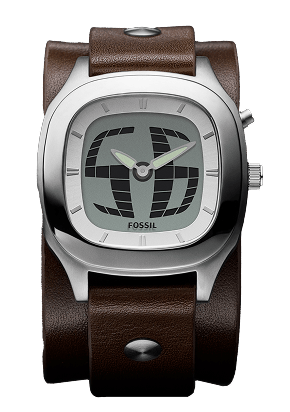
Most 90s Fossil watches are ordinary. The Big Tic is not.
Fossil launched the original in 1998. The concept was simple: put conventional analog hands on the dial, then place an animated LCD behind them. The digital display wasn’t just telling time. It was moving. Scrolling seconds, animated graphics, visual effects that made the watch look alive.
Fossil’s own current marketing describes the Big Tic as “the original ana-digi watch that animated time itself in 1999” . A retail listing for a modern revival notes that the original series was “introduced in the late 1990s and early 2000s” and became known for its “animated digital display and futuristic aesthetic” .
The original Big Tic used two batteries: one for the analog movement, one for the LCD. Different versions had different animations. Fossil’s archive mentions robots, butterflies, flames, waves, Kanji, and flags. There was even a Mickey Millennium Big Tic in 1999.
This is the one 90s Fossil that actually has a reason to be collectible. Not because it’s rare. Because nothing else looked like it.
Other 90s Fossil Watches Worth Knowing
The Hologram Watches (1992)
In March 1992, Fossil launched eight hologram watches simultaneously. Each was priced at $60. The models included names like Fossil Police, Exploding Parts, Fossil Orbit, Tunnel Vision, Route Fossil, Paint in Time, Night Flight, and Fossil All-star. Eight watches at once was an unusual move for a fashion brand. It shows how aggressively Fossil was experimenting with visual gimmicks during the decade.
The Limited Editions
Fossil’s first limited edition was the SK 5038 in March 1992. The company kept a checklist in its Collector’s Club kits, and an Underground Fossil Collectors Club document lists limited editions through December 1994. These weren’t limited in the sense of hand-finished watchmaking. They were limited in the sense of marketing. But for collectors who care about completeness, they matter.
The Defender Series
Launched in the mid-90s, the Defender was Fossil’s attempt at a higher-end line. The original DE series had 43 watches numbered DE-1500 through DE-1544. The later DF series had 24 models split into sub-lines: Spitfire (1000 series), Spinnaker (2000 series), Streamliner (3000 series), Avion (4000 series), and Starboard (5000 series) . One collectors’ source claims the DF series was actually designed and assembled by Zodiac before Fossil bought the company in 2001, which would explain why some DF models retailed at $395. That claim is hard to verify, but it’s the kind of detail that makes the Defender series worth researching if you find one.
What Actually Makes a 90s Fossil Collectible
Most aren’t. A basic quartz three-hand Fossil from 1994 is a $20 watch today. That’s not a criticism. It’s just math. Fossil made a lot of watches, and most of them were meant to be worn and replaced.
The ones that attract attention share a few traits:
| Factor | Why It Matters |
|---|---|
| Big Tic (any variant) | The only 90s Fossil with a genuinely distinctive technical feature |
| Original tin included | Fossil’s own documents emphasize packaging as part of the product |
| Limited editions with documentation | Completeness matters more than rarity for most Fossil collectors |
| Unusual dial designs or collaborations | Disney, holograms, character watches cross collecting categories |
| Defender DF series | Possibly Zodiac-related; higher original price point |
| New old stock condition | A working 30-year-old quartz watch in unused condition is uncommon |
A general resale guide for Fossil puts vintage watches with tins at 60-150% margins for resellers, while watch-only examples sit at 40-80% . Those numbers assume you bought right. They don’t mean every old Fossil is worth flipping.
What to Check Before Buying
These are quartz watches, but that doesn’t mean they’re simple to buy.
Battery leakage. A dead battery left inside for years can corrode the movement. “Probably just needs a battery” is the least useful thing a seller can say. Ask whether the compartment has been inspected.
Big Tic LCD function. If you’re buying a Big Tic, test the animation. A Big Tic that tells time but doesn’t animate is a broken Big Tic. Both battery circuits need to work.
Chronograph operation. Run the chronograph. Start it. Stop it. Reset it. Check that the hands return to zero. The main time display working doesn’t mean the pushers or subdials do.
Plating wear. Many Fossil cases were gold-tone or plated, not solid steel. Wear shows on case edges, crowns, and bracelet surfaces. Ask for photos from the side and underneath.
Bracelet length. A vintage steel Fossil with a short bracelet is annoying. Finding matching links decades later is harder than finding the watch. Ask for the maximum wrist size.
Water resistance. Assume it’s gone. A 90s Fossil might have been rated for 30 or 50 meters when new. Thirty years later, the gaskets are dried out or missing. Keep it away from water.
Original or Modern Revival?
Fossil brought the Big Tic back. The current versions use the same ana-digi concept, with a 41mm case, modern materials, and updated construction. There are also limited-edition World Flags Big Tic models with silicone straps.
If you want the look and don’t care about age, the modern version is easier. You get a new watch, current support, and no risk of dead LCD segments.
If you want the actual 1998 object, buy the original. Just understand what you’re getting: a 27-year-old quartz watch with two batteries, an LCD that may or may not work, and no real service infrastructure behind it.
That’s the trade-off. Period authenticity versus reliability.
FAQ
What Fossil watches were popular in the 90s? Fossil sold a broad range of quartz watches: dress models, chronographs, and sporty steel designs like Fossil Blue. The Big Tic, introduced in 1998, became the most distinctive late-90s model because of its animated LCD behind analog hands.
When did the Fossil Big Tic come out? Fossil dates the original to 1998. Current marketing materials describe it as “the original ana-digi watch that animated time itself in 1999” . The launch year is best understood as 1998, with 1999 variants following.
Why did Fossil watches come in tins? The tins were part of Fossil’s retro-American brand identity. The company started using decorated metal packaging in 1989, and the graphics were inspired by 1950s design. Customers collected them, and complete sets with tins remain more desirable than watch-only examples.
Are 90s Fossil watches collectible? Some are. Big Tic variants, unusual limited editions, hologram watches, and Defender DF models attract more interest than standard quartz dress watches. Age alone doesn’t make a Fossil valuable. The exact reference, condition, and completeness matter more.
How can I tell if my Fossil is from the 90s? Check the case-back reference, movement markings, and original packaging. For Big Tic, the design itself dates it to the late 90s or later. For ordinary models, exact dating is difficult without period catalogs or documentation. Marketplace listings that say “90s” based on appearance aren’t evidence.
Are vintage Fossil watches worth money? Most aren’t. Standard quartz Fossils from the 90s sell for very little. Big Tic models, unusual limited editions, and complete sets with tins can command more, but the margins are modest. A resale guide suggests vintage Fossils with tins flip at 60-150% margins, which means buying low and selling to the right buyer.
Is an original 90s Big Tic worth buying? If you specifically want the late-90s object, yes. Check both the analog movement and the LCD animation before buying. If you just want the Big Tic look, Fossil sells modern revived versions that are easier to live with.