
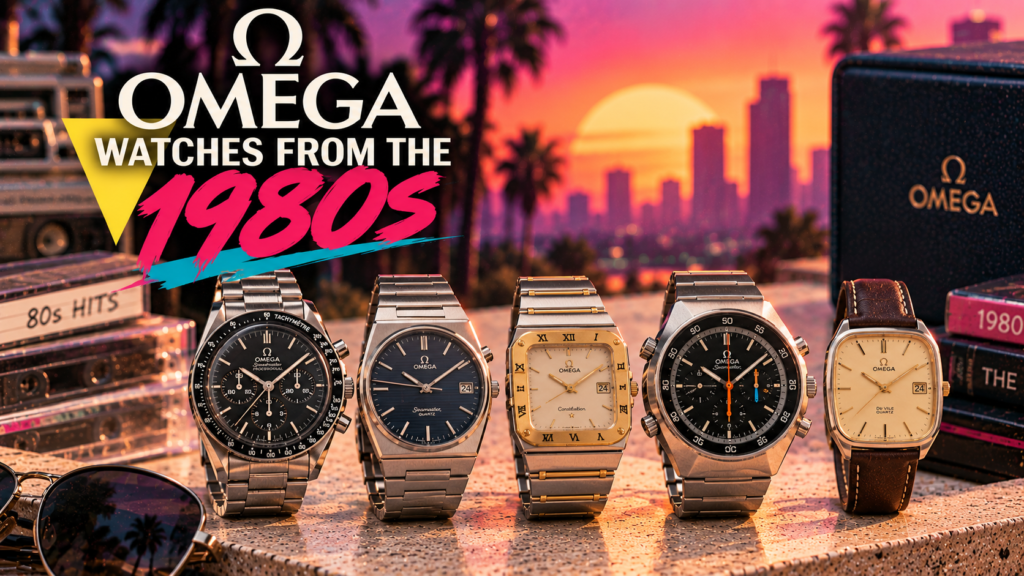
The 1980s are one of the most overlooked periods in Omega’s history.
Ask someone to picture a vintage Omega and they’ll probably imagine a 1960s Speedmaster, an early Seamaster diver or a pie-pan Constellation. Jump forward and the familiar modern Omega catalog begins to appear. The watches between those periods are much harder to summarize.
During the 1980s, Omega produced ultra-thin quartz Constellations, titanium-and-gold Seamasters, integrated bracelets, LCD displays, unusual Speedmasters, moonphase chronographs and plenty of small dress watches that look unmistakably different from the brand’s mid-century output.
That inconsistency is exactly why Omega watches from the 1980s are interesting. Omega wasn’t protecting one established design language. It was adapting to a watch industry transformed by quartz while trying to work out what a premium Swiss watch should look like in the electronic era.
The Omega Watches That Defined the 1980s
A few families explain the decade particularly well.
| Watch | Year | Why It Matters |
|---|---|---|
| Constellation Manhattan | 1982 | Introduced the four-claw Constellation design |
| Seamaster Polaris | 1982 | Gérald Genta design, titanium and gold |
| Speedmaster Mark V | 1984 | Final official Speedmaster Mark-series model |
| Speedmaster Moonphase | Mid-1980s | Rare moonphase chronograph variations |
| Seamaster Polaris Multifunction | 1980s | Analog-digital interpretation of the Polaris |
| Classic Speedmaster Professional | Throughout decade | Traditional Moonwatch continued alongside newer designs |
A Constellation Manhattan and a Speedmaster Professional could hardly look more different, yet both belong to the same period.
1982 Was a Crucial Year for Omega
If you want one year that explains 1980s Omega, start with 1982.
Two particularly important watches appeared: the Constellation Manhattan and the Seamaster Polaris. Both embraced the integrated, geometric aesthetic associated with the period, but they arrived there in very different ways.
The Manhattan would establish a design language Omega still uses in the Constellation collection more than four decades later. The Polaris went in a more experimental direction with titanium, gold and Gérald Genta styling. Neither looked particularly interested in recreating Omega’s 1950s watches. That was the point.
Constellation Manhattan: The Omega That Still Looks Like the 80s
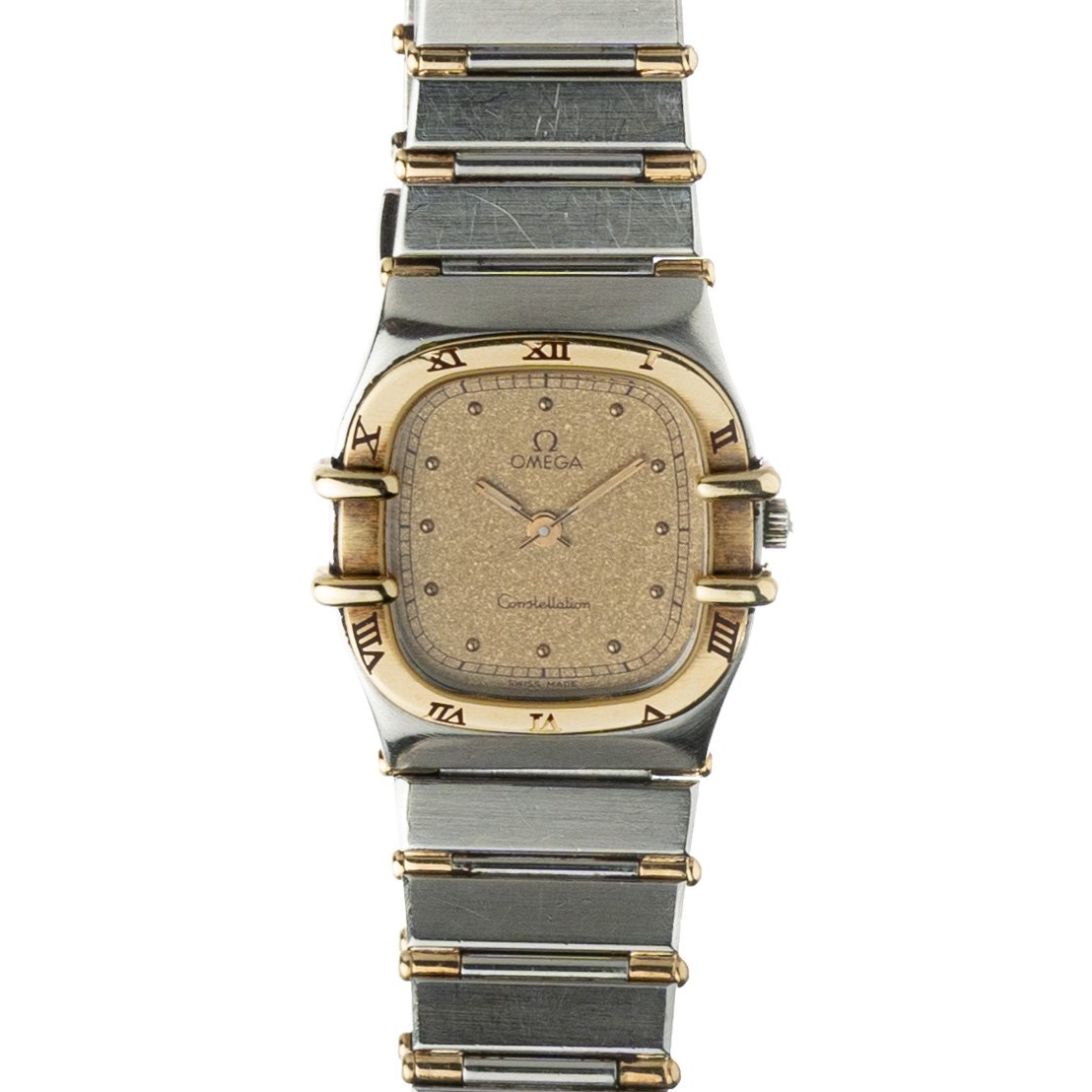
The original Constellation Manhattan debuted in 1982. It was designed by Carol Didisheim, a young design student from La Chaux-de-Fonds who joined Omega straight after completing her studies. She was 26 at the time.
The design introduced several features that became fundamental to the modern Constellation: an integrated bracelet, slim profile and four distinctive claws positioned around the case. Those claws weren’t originally decoration. On the first Manhattan, they helped secure the sapphire crystal and compress the seals. Omega could therefore eliminate a conventional bezel and make the watch unusually thin. The Roman numeral hour markers were printed on the underside of the crystal rather than mounted conventionally on the dial, another measure that helped reduce thickness.
The idea came from an unlikely source. Pierre-André Aellen, Omega’s product director at the time, noticed that his unframed bathroom mirror was held on the wall with metal claws. Didisheim adapted the concept for the watch case.
The original Manhattan used Omega caliber 1422, an ultra-thin quartz movement. That’s important when evaluating vintage Omega today. Collectors who automatically dismiss quartz will miss a substantial part of what Omega was doing in this period. Quartz helped make the extremely slim architecture possible. The movement was chronometer-certified, ran in 7 jewels, and featured a rate trimmer for fine adjustment.
Omega subsequently introduced caliber 1431 and also produced mechanical Manhattan variants. But if you want a watch that really represents early-1980s Omega, an original quartz Manhattan arguably makes more historical sense than trying to avoid quartz altogether.
The Four Claws Outlived Their Original Purpose
On the original Manhattan, the claws were functional components of the case construction. Later versions changed the construction, but Omega kept them. They had become recognizable enough to survive after their original engineering purpose disappeared.
Modern Constellations still use the claws and characteristic half-moon case details, and Omega continues to explicitly connect current models with the design introduced in 1982. In the current collection, the claws are decorative rather than practical elements, serving to visually link the watches of today with the original from 1982.
Seamaster Polaris: Gérald Genta’s Other Omega
The other big 1982 release was completely different. The Omega Seamaster Polaris was designed by Gérald Genta. Genta is much more closely associated with watches such as the Audemars Piguet Royal Oak and Patek Philippe Nautilus, so his Omega work receives considerably less attention. The Polaris still shows familiar elements of his approach: a strong relationship between case and bracelet, geometric forms and a watch that feels designed as one continuous object rather than a round case attached to a generic bracelet.
But the material combination is what makes the original Polaris especially interesting. The first Polaris combined titanium with gold inlays. Omega’s historical material identifies the 1982 Seamaster Polaris as its first watch marketed in titanium. Titanium was light, corrosion-resistant and technically difficult to machine, particularly at the time.
Then Omega added gold. It’s a very 1980s combination. Titanium communicates technology. Gold communicates luxury. Instead of choosing between those ideas, Omega put both in the same watch.
The result doesn’t look like a conventional dive watch despite carrying the Seamaster name. It is slim, integrated and unmistakably a product of the period.
Omega used tennis star John McEnroe in advertising for the Polaris during the 1980s. Interestingly, period advertising sometimes referred to the watch simply as the Omega Titanium, emphasizing the unusual material rather than relying entirely on the Seamaster name. That tells us something about how the watch was positioned. Titanium itself was part of the attraction. Today, titanium watches are everywhere from affordable Citizen models to high-end Swiss sports watches. In 1982, putting the material front and center made considerably more sense.
Polaris Became More Than One Watch
Don’t assume every Seamaster Polaris has the same movement or display. Omega expanded the family into numerous configurations, including quartz and analog-digital versions.
One of the more interesting is the Polaris Multifunction, which combines conventional hands with a digital display. A surviving example documents the specifications: caliber 1665 quartz movement, approximately 35mm case including crown, titanium and solid gold construction, and a hidden LCD digital display beneath the analog hands. The single winding crown operates digital time, seconds, chronograph, alarm, dual time zone, timer and date.
That version is particularly representative of the period because it mixes a premium metal case and integrated bracelet with electronic functionality. It doesn’t hide the fact that it is quartz. It makes the electronics part of the design.
The Speedmaster Never Went Away
Meanwhile, Omega continued making the Speedmaster Professional. That’s an important correction to the idea that the 1980s were simply Omega’s “quartz period.” Traditional mechanical watches remained in the catalog.
The familiar Moonwatch architecture therefore existed alongside quartz Constellations, titanium Seamasters and experimental digital displays. This coexistence is what makes the decade so unusual. Omega didn’t replace its mechanical history. It surrounded it with new ideas.
Speedmaster Mark V: A Very Different Speedmaster
The Speedmaster Mark V arrived in 1984 as the final official model in the Speedmaster Mark series. It used Omega caliber 1045, based on the Lemania 5100.
The Mark V was based on a design Omega had already introduced in 1982, a reference 345.0803 Speedmaster that was solely intended for the West German market. Omega refers to this as the “Smooth Line” Speedmaster collection. It’s a common misconception that the Mark V was produced for the German market only. It was more widely available.
Forget the familiar Moonwatch case for a moment. The Mark V uses the smoother integrated case styling associated with Omega’s German-market Speedmasters of the period. The dial is also much busier than a standard Moonwatch because of the caliber 1045 chronograph layout, with the minute counter positioned at the center.
It is recognizably a Speedmaster once you know what you’re looking at. But it certainly isn’t the Speedmaster most casual buyers picture. That’s exactly why it’s interesting.
The Lemania 5100 movement is respected by tool-watch enthusiasts for being a solid workhorse, though purists may not like the use of plastic or nylon parts. It isn’t aesthetically beautiful, but it functions reliably.
The Speedmaster Also Got a Moonphase
Omega wasn’t finished experimenting with the Speedmaster. During the middle of the decade it produced rare Speedmaster Moonphase references.
The reference 345.0809 was introduced in 1985 and was in production until 1988. It was made in less than 1,300 units. The reference contained a modified caliber 861, the cal. 866, which added a moon phase and date.
These are a useful counterpoint to the idea that 1980s Omega was dominated by cheap electronic watches. Some of the company’s most unusual mechanical Speedmasters came from this same decade. They just aren’t nearly as visible as the standard Moonwatch.
1980s Omega Wasn’t One Design Movement
Compare three watches:
Constellation Manhattan – thin, integrated, quartz-first, jewelry-like, technically unusual case construction.
Seamaster Polaris – titanium, gold, Gérald Genta, quartz and multifunction possibilities, futuristic sports-luxury aesthetic.
Speedmaster Mark V – mechanical automatic chronograph, smooth integrated case, Lemania-derived movement, unmistakably functional dial.
They don’t look as though one committee designed them. And that’s fine. The 1980s were a transitional period for the entire Swiss watch industry. Omega was exploring several possible futures at once.
Why Are Some 80s Omegas So Small?
Another surprise for modern buyers is size. Many dress-oriented Omega watches from this period are significantly smaller and thinner than today’s men’s watches. That doesn’t automatically mean they’re women’s models. Thin quartz movements allowed extremely slim cases, and smaller watches were normal.
The integrated-bracelet design also changes how a watch wears. A relatively modest case can have much more wrist presence when the bracelet visually flows directly from it.
A 35mm Polaris Multifunction, for example, wears quite differently from a conventional modern 35mm dress watch because of the integrated case and bracelet.
Don’t buy based solely on diameter. Look at case width, bracelet width, total thickness, bracelet articulation and photos on a wrist similar to yours.
Two-Tone Makes Much More Sense Here
Two-tone watches go in and out of fashion. On an 80s Omega, gold and steel can actually improve the historical character. The decade embraced yellow gold, integrated bracelets and strong contrast between materials. The original Polaris literally combined gold with titanium, while Constellation Manhattan models appeared in steel, two-tone and precious-metal configurations.
So I wouldn’t automatically search only for stainless steel. If you’re buying a 1980s watch because you like the period, removing everything visually associated with that period defeats the purpose. A two-tone Manhattan should look a little 80s.
What About Omega Quartz Watches From the 1980s?
They deserve more attention than they usually receive. The biggest advantage is obvious: some offer distinctive Omega design without the prices attached to the company’s most collectible mechanical references.
But quartz vintage watches require a different type of caution. Mechanical watches can often be repaired by manufacturing or adapting components. A failed vintage electronic module can be much more difficult.
Before buying an old quartz Omega, determine the exact caliber and research whether it currently runs, battery condition, evidence of battery leakage, availability of replacement movements or donor parts, whether all digital segments work, whether multifunction controls work, and whether the correct movement is still installed.
“Needs battery” is not enough. Treat an untested watch as untested.
Don’t Ignore Bracelet Condition
For many Omega watches from the 1980s, the bracelet is central to the design. That’s particularly true for the Constellation Manhattan and Seamaster Polaris.
A missing link isn’t merely a minor inconvenience. Finding correct vintage links can be difficult and expensive. Replacing the original bracelet with leather may also destroy the entire integrated appearance of the watch.
Before buying, ask for the maximum wrist circumference. Also inspect bracelet stretch, damaged links, clasp condition, missing screws or pins, excessive polishing and mismatched replacement sections.
I’d rather buy a slightly scratched complete watch than a prettier one with an incomplete proprietary bracelet.
Polishing Can Hurt These Watches
This matters more than usual because 1980s Omega design often relies heavily on case geometry and surface contrast. Sharp transitions between brushed and polished sections can disappear after aggressive refinishing.
The Polaris is especially dependent on its unusual material treatment. The Manhattan depends on its thin, architectural shape.
A vintage watch doesn’t need to look new. Some scratches are normal. Over-polishing away the original geometry to remove forty years of wear can make the watch less attractive, not more.
Check the Crystal and Claws on a Manhattan
For an early Constellation Manhattan, the crystal is more than a transparent cover. Remember that the original construction used the claws as functional components, and markings could be printed beneath the sapphire.
That means originality matters. If you’re looking at an early example, research the exact reference and compare the dial, crystal printing, claws, hands and bracelet against documented examples.
The more unusual the construction, the less comfortable I’d be buying a watch assembled from uncertain replacement parts.
Vintage Water Resistance Means Very Little Without Testing
The Seamaster name can create false confidence. Don’t assume a vintage Polaris is safe for swimming because it says Seamaster. Don’t assume another 1980s Omega remains water resistant because the original specification says so.
A forty-year-old watch may have hardened gaskets, worn crown seals, a replacement crystal, damaged case surfaces, an improperly fitted case back, or decades of unknown servicing.
If water resistance matters, have the individual watch pressure-tested. The original specification tells you what Omega designed. It doesn’t tell you the condition of the watch in your hand.
How to Identify a 1980s Omega
Start with the reference and movement, not the seller’s description. Omega produced too many variations during this period to identify everything reliably from the dial alone.
For any potential purchase, try to establish exact reference, caliber, approximate production period, correct dial configuration, correct hands, correct bracelet, correct case material and service history if available.
Serial numbers can help with dating, but don’t use a generic online serial chart as your only evidence. For important or expensive watches, Omega’s archival documentation and specialist reference material are much more useful.
Are Omega Watches From the 1980s Valuable?
Some are expensive. Others remain relatively accessible by vintage Omega standards. But “1980 Omega watch” isn’t a useful valuation category by itself.
A standard quartz dress watch, early Manhattan, titanium Polaris and rare Speedmaster Moonphase have completely different collector markets. What matters is the individual reference.
The factors I’d prioritize are exact model, rarity, originality, condition, movement health, bracelet completeness, documented history, unusual materials and historical significance.
Don’t confuse an ambitious asking price with market value. For less common references, look for completed sales rather than one optimistic dealer listing.
Which 1980s Omega Should You Buy?
For the strongest pure 1980s design, I’d start with the Constellation Manhattan. It arrived in 1982, introduced design elements Omega still uses, and looks completely at home in its period.
For something stranger, I’d choose the Seamaster Polaris. The Gérald Genta connection, titanium-and-gold construction and integrated design make it much more interesting than its relatively low profile suggests.
For a mechanical-watch collector, the Speedmaster Mark V is the more obvious rabbit hole.
And if you simply want a wearable vintage Omega rather than a historically important reference, don’t ignore ordinary quartz dress watches from the decade. Some are beautifully thin, inexpensive relative to famous vintage Omegas and unmistakably period-correct.
The model that costs the most isn’t necessarily the model that best represents the decade.
Why 1980s Omega Deserves More Attention
Omega’s 1960s story is easier to sell. Moon landing. Speedmaster. Seamaster. Mechanical movements. Classic proportions.
The 1980s require more explanation. But that’s also what makes them interesting. The company was working with quartz chronometers, titanium, gold, integrated bracelets, multifunction displays and unconventional case construction while continuing to develop mechanical Speedmasters.
The 1982 Constellation Manhattan created a visual identity that remains recognizable in Omega’s current catalog. The 1982 Seamaster Polaris combined Gérald Genta design with titanium at a time when the material was still unusual in luxury watches. The 1984 Speedmaster Mark V showed how far the Speedmaster could move visually from the Moonwatch without abandoning mechanical chronograph engineering.
That’s the real appeal of Omega watches from the 1980s. You’re looking at a major Swiss manufacturer trying to decide which parts of its past should survive and what the luxury watch of the future should become.
FAQ
What Omega watches were popular in the 1980s? The decade included the Speedmaster Professional, Constellation Manhattan, Seamaster Polaris and numerous quartz dress and sports watches. The Manhattan and Polaris are especially representative because both debuted in 1982 and embraced distinctly 1980s materials and integrated design.
What Omega watch was introduced in 1982? Two important examples arrived in 1982: the Constellation Manhattan and Seamaster Polaris. The Manhattan introduced the recognizable four-claw Constellation design, while the Genta-designed Polaris combined titanium with gold.
Who designed the Omega Constellation Manhattan? The original 1982 Constellation Manhattan was designed by Carol Didisheim, a young design student who joined Omega after completing her studies. She was 26 at the time. Its four claws initially helped secure the sapphire crystal and contributed to the watch’s thin construction.
Did Gérald Genta design an Omega watch? Yes. Gérald Genta designed the Omega Seamaster Polaris, introduced in 1982. The original model combined titanium and gold and featured an integrated bracelet and slim geometric case.
Did Omega make quartz watches in the 1980s? Yes, extensively. Quartz was important to Omega’s 1980s catalog. The original Constellation Manhattan used quartz caliber 1422, while the Seamaster Polaris family included numerous quartz configurations.
What is the Omega Speedmaster Mark V? The Speedmaster Mark V was introduced in 1984 and became the final official model of the Speedmaster Mark series. It used Omega caliber 1045, based on the Lemania 5100.
Are 1980s Omega quartz watches collectible? They can be. Early Constellation Manhattan and Seamaster Polaris references have clear historical and design interest, while rarer configurations can attract specialist collectors. Exact reference, originality, condition and movement health matter more than simply being old.
Are Omega watches from the 1980s worth buying? They can be particularly interesting if you want vintage Omega beyond the familiar 1960s models. The Constellation Manhattan, Seamaster Polaris and less common Speedmasters offer distinctive period design, but vintage quartz electronics, proprietary bracelets and replacement parts should be checked carefully before purchase.