
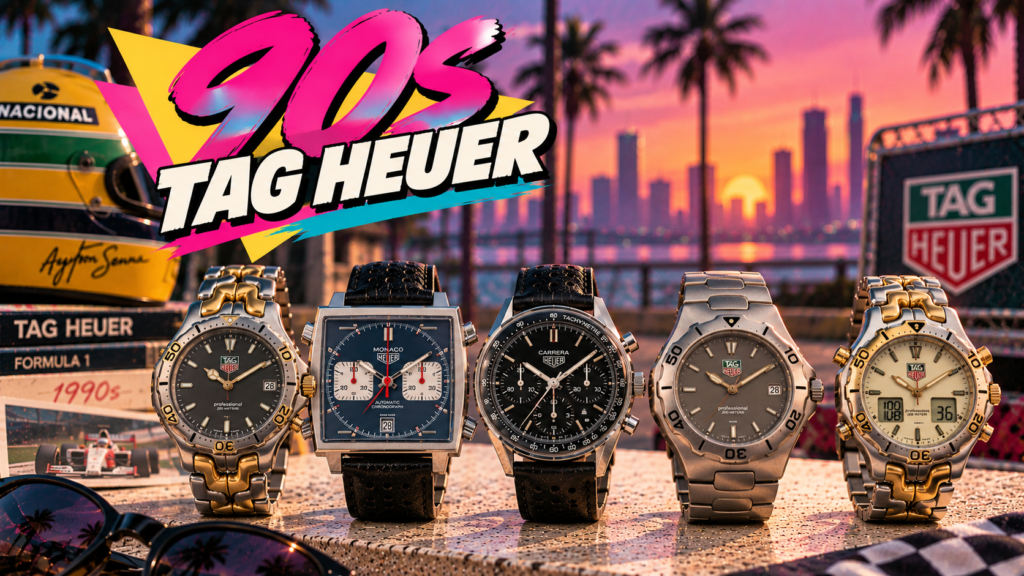
A 90s TAG Heuer usually looks nothing like the vintage Heuer chronographs collectors chase from the 60s and 70s. Instead of slim Carreras and colorful Monacos, the early 1990s catalog was built on quartz sports watches, rotating bezels, integrated bracelets, and a design formula TAG Heuer called the Six Features. S/el, 2000, 4000, and later 6000 Series watches defined the brand’s identity.
Then something shifted. In 1996, TAG Heuer brought back the Carrera. The Monaco followed. By the end of the decade, the company was selling unmistakably 1990s sports watches and rediscovering the racing chronographs that made Heuer famous decades earlier.
That makes the 1990s one of the most important transitional periods in TAG Heuer history.
The TAG Heuer Watches That Defined the 1990s
| Watch / Collection | 1990s Milestone | Why It Matters |
|---|---|---|
| S/el | Throughout the decade | Flagship sports-luxury design and Senna connection |
| S/el Digital Chronograph | Early 1990s | Analog-digital timing with distinctive integrated bracelet |
| 4000 Series | 1991 | Middle ground between utilitarian 2000 and premium S/el |
| 6000 Series | Mid-1990s | Became TAG Heuer’s premium sports-watch line |
| Carrera Re-Edition | 1996 | Brought classic Heuer design back into the catalog |
| Kirium | 1997 | New streamlined design replaced the 4000 Series |
| Monaco Re-Edition | 1997/98 | Revived another major Heuer chronograph |
| Link | 1999 | S/el evolved into the Link collection |
An S/el represents the TAG Heuer that entered the 1990s. A 1996 Carrera represents the company beginning to look backward at its own history. Both are authentically 90s TAG Heuers.
The Six Features Defined Early 90s TAG Heuer
To understand TAG Heuer watches from the 90s, start with six specifications:
- 200-meter water resistance
- Screw-down crown
- Double-safety bracelet clasp
- Unidirectional rotating bezel
- Sapphire crystal
- Luminous dial, hands, and bezel markings
TAG Heuer applied this formula across several collections. It gave watches at different price levels a recognizable family resemblance and reinforced the company’s sports-watch positioning.
It was commercially effective, but there was a downside. Many collections started looking related enough that their individual identities became less obvious. TAG Heuer later acknowledged this problem when discussing the strategic shift that followed the Carrera revival. For collectors today, those similarities are part of what makes a watch immediately recognizable as early-1990s TAG Heuer.
S/el Is Probably the Most 90s TAG Heuer
If one collection visually captures the decade, it’s the S/el. The name stood for Sports Elegance.
Technically, the collection began before the 1990s, but it remained in TAG Heuer’s catalog from 1987 through 1999 and became one of the company’s defining watches during the following decade. TAG Heuer positioned it above the 1000 and 2000 Series, describing the concept as suitable with both a diving suit and a dinner jacket.
The case is distinctive. The bezel has an aggressive saw-tooth edge, while the rest of the watch uses softer curves than many earlier TAG Heuer sports watches. But the bracelet is what really matters.
Each S/el bracelet link consists of two curved metal sections that create an unusual S-like shape. The bracelet wasn’t merely attached to the case. The case was designed around it, creating a highly integrated appearance. On early models, fitting an ordinary leather strap wasn’t even straightforward because the bracelet links effectively acted as the end pieces.
That design became so closely associated with TAG Heuer that the S/el was renamed Link in 1999. A generic replacement bracelet can remove a large part of what makes an S/el interesting. Bracelet condition and completeness matter almost as much as the watch head.
Ayrton Senna and the S/el
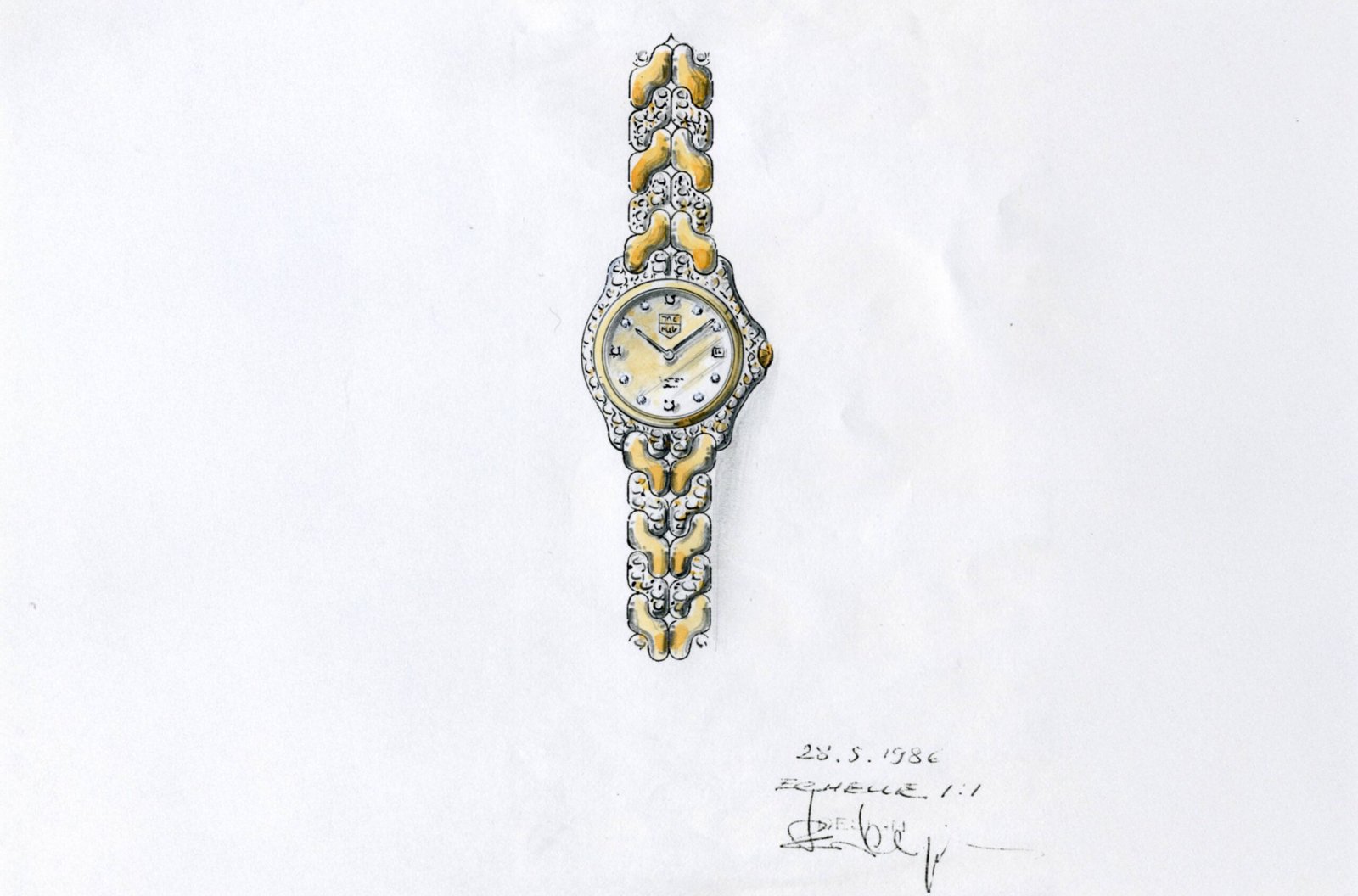
The S/el also has one of TAG Heuer’s strongest Formula One connections. Ayrton Senna wore the watch as an everyday piece, and TAG Heuer’s history notes his association with the development of its distinctive bracelet.
One particularly interesting version is the S/el Digital Quartz Chronograph. Introduced in 1990, it combined an analog dial with two small digital displays positioned around 4 and 8 o’clock. The chronograph offered 1/100-second precision. Senna wore a bi-metal version with an eggshell-colored dial, reference S.25706C. TAG Heuer identifies this as one of his favorite watches.
This is much more representative of early-1990s TAG Heuer than buying a modern watch simply because it carries Senna branding. It’s the kind of watch he actually wore during the period.
A steel-and-gold S/el can look extremely 1990s. That’s not a criticism. TAG Heuer specifically identifies plated gold and stainless steel as a signature S/el combination from the era. Modern buyers often default to stainless steel because it’s easier to wear and less obviously period-specific. But if you’re deliberately buying a vintage 90s TAG Heuer, the bi-metal versions arguably make more historical sense.
The same applies to smaller cases, integrated bracelets, and quartz movements. Removing every unfashionable 1990s feature eventually leaves you with a watch that doesn’t represent the 1990s very well.
S/el Wasn’t Just Quartz
Quartz dominated much of TAG Heuer’s catalog, but the S/el family became surprisingly broad. TAG Heuer documents seven major variations during its production life: quartz watch, quartz chronograph, digital quartz chronograph, automatic watch, automatic chronometer, automatic chronograph, and S/el Leather series.
Mechanical watches returned to the S/el line in 1991, when TAG Heuer began reintroducing mechanical options more broadly. This is useful for collectors who like the S/el design but don’t necessarily want quartz. Just don’t assume an automatic S/el is inherently more historically important because it’s mechanical. Quartz was central to TAG Heuer’s identity during this period.
The 4000 Series Arrived in 1991
TAG Heuer introduced the 4000 Series in 1991. Its job was surprisingly specific. The company already had the utilitarian 2000 Series and the more elegant S/el. The 4000 was designed to occupy the middle ground between them.
It retained the Six Features and 200-meter sports-watch formula, but its styling and positioning were slightly more upscale than the basic dive-watch lines. Unlike several other TAG Heuer collections, the 4000 Series remained relatively simple. TAG Heuer never expanded it into a chronograph family. It consisted of time-only watches.
That simplicity can make the 4000 easy to overlook today. But it’s a useful snapshot of how TAG Heuer organized its catalog during the early 1990s. One unusual detail is the prominent TAG Heuer shield positioned at the top of the case. It sounds minor, but visually it gives the watch a recognizable identity even before you study the dial. The collection remained available through most of the decade before being effectively replaced by the Kirium around 1998/99.
TAG Heuer Was Selling an Attitude, Too
From 1991 to 1994, the company ran its “Don’t Crack Under Pressure” campaign around athletes including Ayrton Senna and Michael Schumacher. From 1995 through 1997 came the psychologically themed “Success. It’s a Mind Game.” campaign.
Those advertisements fit the watches. Early-1990s TAG Heuer wasn’t selling quiet traditional Swiss elegance. The brand emphasized pressure, sport, performance, and competitive personalities. That’s useful context when looking at an S/el or 4000 today. Their aggressive bezels and technical appearance weren’t accidental.
Then TAG Heuer Changed Direction
By the middle of the decade, TAG Heuer had a problem. Its catalog was coherent, perhaps too coherent. The 1000, 1500, 2000, 4000, and 6000 Series largely followed related sports-watch ideas and shared the Six Features philosophy. Different collections occupied different price positions, but the visual distinction wasn’t always dramatic.
The company eventually found another direction by looking somewhere obvious: its own past. In 1996, TAG Heuer brought back the Carrera. This decision looks predictable now because heritage reissues are everywhere. At the time, it was much more consequential.
Carrera Returned in 1996
The Carrera had disappeared from TAG Heuer’s catalog after 1985. For the 1996 Carrera Re-Edition, TAG Heuer went back to Jack Heuer’s original 1963 design and recreated it remarkably closely. Three initial references were produced:
| Reference | Configuration |
|---|---|
| CS3110 | White dial, stainless steel |
| CS3111 | Black dial, stainless steel |
| CS3140 | White dial, 18k gold |
The steel cases measured 36 mm, maintaining the compact proportions of the original Carrera. They also preserved the basic pusher, crown, dial, and subdial geometry of the 1963 watch. That’s a dramatic contrast with the S/el. One looks forward from the late 1980s. The other deliberately looks backward to 1963. Both were being sold during the same decade.
There’s a detail collectors should notice. The 1996 Carrera Re-Edition used the historic Heuer shield, rather than putting modern TAG Heuer branding prominently on the dial. That was part of the attempt to recreate the original watch faithfully. There is also a useful way to distinguish it from an original 1963 Carrera: TAG Heuer notes that original watches carried “Carrera” above the Heuer shield, while the 1996 re-editions did not.
This matters because the re-edition itself is now around three decades old. We’re at the slightly strange point where a watch designed to imitate a vintage watch has become vintage enough to collect in its own right.
TAG Heuer didn’t put a quartz movement inside the revived Carrera. The 1996 watches used the manual-winding Lemania 1873. That allowed TAG Heuer to keep the case close to the dimensions of the original Carrera while offering a traditional mechanical chronograph experience. It also sent a broader signal. The company wasn’t abandoning modern quartz sports watches, but mechanical heritage was becoming important again. That strategy would become much more significant over the following decades.
The Monaco Came Back in 1997
TAG Heuer followed the Carrera with a Monaco re-edition in 1997. But “re-edition” needs quotation marks here. The new CS2110 did not simply recreate Steve McQueen’s famous blue Monaco from Le Mans. Instead, TAG Heuer used a black dial with two black registers and produced the watch as a limited edition of 5,000 pieces.
This is an important detail because modern expectations can distort how we remember the launch. The first revived Monaco wasn’t blue. The familiar blue McQueen-style Monaco would return later, in 2003.
A second version, the CS2111, followed with three registers. Its dial introduced a circular-within-square design language that TAG Heuer would use on later Monaco chronographs. By 1998, the success of this design led TAG Heuer to put a version into the permanent range as the CW2111, now carrying TAG Heuer branding. A silver/white CW2112 joined it.
So if you’re looking for an authentically 90s Monaco, don’t automatically search for blue. Black is arguably more representative of the actual revival.
What About the Kirium?
The Kirium arrived late in the decade and represents another side of TAG Heuer. The collection effectively replaced the 4000 Series and continued into the 2000s. TAG Heuer dates that transition to around 1997-1999.
Where the older 4000 looked like a traditional TAG Heuer sports watch, the Kirium moved toward a smoother, more integrated design. This makes it interesting for a 90s collection because it shows where the company’s non-heritage watches were heading while Carrera and Monaco were reconnecting with the past. One branch was becoming more modern. The other was becoming more historical.
Quartz or Mechanical?
For this decade, resist the temptation to treat mechanical as automatically superior. If you want the Carrera Re-Edition, the mechanical movement is part of the appeal. But if you want an S/el associated with Ayrton Senna or a representative early-1990s TAG Heuer sports watch, quartz may actually be the more historically appropriate choice.
Quartz was not a compromise accidentally imposed on these watches. It was central to the catalog. A collector interested in the decade rather than movement prestige should judge each watch within its original context.
What to Check Before Buying a 90s TAG Heuer
These watches are now roughly 27 to 36 years old, depending on reference. Condition matters.
Bracelet completeness. This is especially important for S/el and other integrated designs. Check the maximum wrist circumference and count the links. Finding the correct discontinued links later can turn an inexpensive purchase into an annoying project.
Plated surfaces. Two-tone S/el watches are extremely period-correct, but inspect gold-plated areas carefully. Wear can be particularly visible around bezel edges, bracelet links, clasp, crown, and case corners. Some wear is normal. Heavy polishing intended to hide it can be worse.
Quartz movement condition. “Needs battery” isn’t a diagnosis. A battery left inside for years can leak and damage contacts or electronics. Ask whether the watch has actually been inspected.
Digital displays. For an analog-digital S/el, check both LCD windows and every function. Missing LCD segments can be much harder to solve than replacing a normal battery.
Mechanical chronographs. For Carrera and Monaco chronographs, test winding, timekeeping, chronograph start, stop, reset, and hour and minute counters. Service history becomes increasingly important as these watches age.
Don’t Trust the Original 200-Meter Rating
Many TAG Heuers from this period were built around genuine 200-meter water resistance. That was one of the Six Features. But a 1992 watch isn’t automatically a 200-meter watch today. The case may have been opened for multiple battery changes. Gaskets may have hardened. Crowns and tubes wear. Crystals get replaced.
Treat the printed rating as an original specification until the individual watch has been properly inspected and pressure-tested. I wouldn’t swim with an untested vintage TAG Heuer simply because “200 METERS” is printed on the dial.
Be Careful With Polishing
The watches from this decade use a lot of contrasting surfaces. S/el models in particular combine polished and matte sections across complicated bracelet links and cases. TAG Heuer itself notes the deliberate use of contrasting finishes. Aggressive polishing can erase that contrast.
A watch with honest scratches but intact geometry can be more attractive than one polished until every surface has the same shine. Ask for close photographs under neutral lighting.
How to Identify a 90s TAG Heuer
Start with the reference number. Don’t buy based on a seller writing “Rare vintage 1990s TAG Heuer Senna.” Determine what it actually is.
For S/el, compare dial layout, bracelet, bezel, movement type, case size, and reference. For Carrera, references such as CS3110, CS3111, and CS3140 give you a much clearer starting point. For Monaco, determine whether you’re looking at the limited CS2110, later CS2111, or permanent-range CW2111/CW2112. Precise identification matters much more than a vague “90s TAG.”
Are 90s TAG Heuer Watches Valuable?
Some are considerably more collectible than others. The 1996 Carrera Re-Edition has an obvious historical story, a mechanical movement, and close connection to the original 1963 Carrera. Early revived Monacos have their own appeal. Senna-associated S/el references attract another group of enthusiasts. More ordinary quartz 2000 and 4000 Series watches can still be relatively accessible.
Age alone doesn’t establish value. Look at exact reference, originality, movement condition, bracelet completeness, dial condition, service history, box and papers, historical significance, and production numbers where reliably documented. And as always, asking price isn’t the same thing as a completed sale.
Which 90s TAG Heuer Should You Look For?
There are three particularly interesting directions.
For the most unmistakable 1990s TAG Heuer aesthetic, look at the S/el. Its bracelet, bezel, and two-tone options couldn’t belong to many other periods.
For motorsport history, a Senna-associated S/el Digital Quartz Chronograph is especially interesting because Senna actually wore the model family during the era.
For mechanical watch collecting, the 1996 Carrera Re-Edition is difficult to ignore. It’s restrained, historically important, and represents the moment TAG Heuer rediscovered a major part of its identity.
And if you want something less obvious, look at the first black Monaco CS2110 rather than immediately jumping to the later blue McQueen aesthetic.
The interesting thing is that none of these choices represents the decade alone. Together, they explain it.
Why TAG Heuer Watches From the 90s Matter
TAG Heuer entered the decade as a modern sports-watch company. The S/el sat near the top of the range. Quartz was normal. Integrated bracelets, 200-meter water resistance, rotating bezels, and sapphire crystals defined the product strategy.
By 1996, TAG Heuer was also making a 36 mm hand-wound Carrera that deliberately looked like something from 1963. Then the Monaco returned. In 1999, the S/el became the Link, and LVMH acquired TAG Heuer.
That’s a remarkable amount of change in ten years. The 1990s weren’t simply an awkward period between vintage Heuer and modern TAG Heuer. They were the decade when the company learned how to combine both identities.
FAQ
What TAG Heuer watches were popular in the 90s? The S/el, 2000, and 4000 Series were important during the decade, with the 6000 Series moving into the premium end of the range. TAG Heuer also introduced the Carrera Re-Edition in 1996 and revived the Monaco near the end of the decade.
What TAG Heuer did Ayrton Senna wear? Senna was closely associated with the TAG Heuer S/el. TAG Heuer specifically documents his use of a bi-metal S/el Digital Quartz Chronograph with an eggshell-colored dial, reference S.25706C.
When did the TAG Heuer Carrera return? TAG Heuer reintroduced the Carrera in 1996 after it had been absent from the catalog since 1985. The first three re-editions were references CS3110, CS3111, and CS3140.
When did TAG Heuer bring back the Monaco? TAG Heuer followed the Carrera revival with a Monaco re-edition in 1997. The first model was the black-dial CS2110, limited to 5,000 watches. The Monaco subsequently expanded into the permanent collection.
Was the 90s TAG Heuer Monaco blue? The first revived Monaco was not the familiar blue Steve McQueen design. The CS2110 used a black dial with two black registers. A blue McQueen-style Monaco joined TAG Heuer’s catalog later, in 2003.
What happened to the TAG Heuer S/el? The S/el remained in the range through 1999 and was then renamed Link, referencing its distinctive integrated bracelet design.
Are 90s TAG Heuer watches quartz? Many are, but not all. Quartz was extremely important to TAG Heuer during the period, while the S/el also gained automatic versions and the revived Carrera used a hand-wound Lemania 1873 chronograph movement.
Are 90s TAG Heuer watches collectible? Yes, although interest varies considerably by reference. Senna-associated S/el watches, early Carrera Re-Editions, and the first revived Monaco models have particularly clear historical stories. For more common models, originality, condition, and a complete proprietary bracelet can matter more than age alone.